

BLE vs. LoRaWAN vs. NB-IoT vs. Wi-Fi HaLow: A Decision Framework for 2026 IoT Products

- Sept 02, 2026 |
- By Deep Gajera - Bluepixel Team

BLE vs. LoRaWAN vs. NB-IoT vs. Wi-Fi HaLow: A Decision Framework for 2026 IoT Products
If you're picking a connectivity stack for a new IoT product in 2026, you've probably already hit the wall every hardware team hits eventually: there is no single "best" protocol, only the one that fits your range, power budget, and business model. BLE, LoRaWAN, NB-IoT, and Wi-Fi HaLow all solve real problems, and all of them get pitched as the obvious choice by someone with a stake in the outcome. This piece is a working framework for BLE vs. LoRaWAN vs. NB-IoT vs. Wi-Fi HaLow decisions, built for product managers and technical founders who need to commit to a radio before the hardware gets locked down, not for radio engineers arguing spec sheets for fun.
We'll walk through the trade-offs that actually change outcomes: range and bandwidth, the certification and carrier costs nobody puts in the pitch deck, what each protocol does to your battery life math, and when running two protocols together beats picking one. Along the way we'll look at how these choices play out in logistics, agriculture, and asset tracking, because the right answer for a pallet tracker is often the wrong answer for a soil sensor.
Range, Power, and Bandwidth: The Trade-Off Triangle You Can't Escape
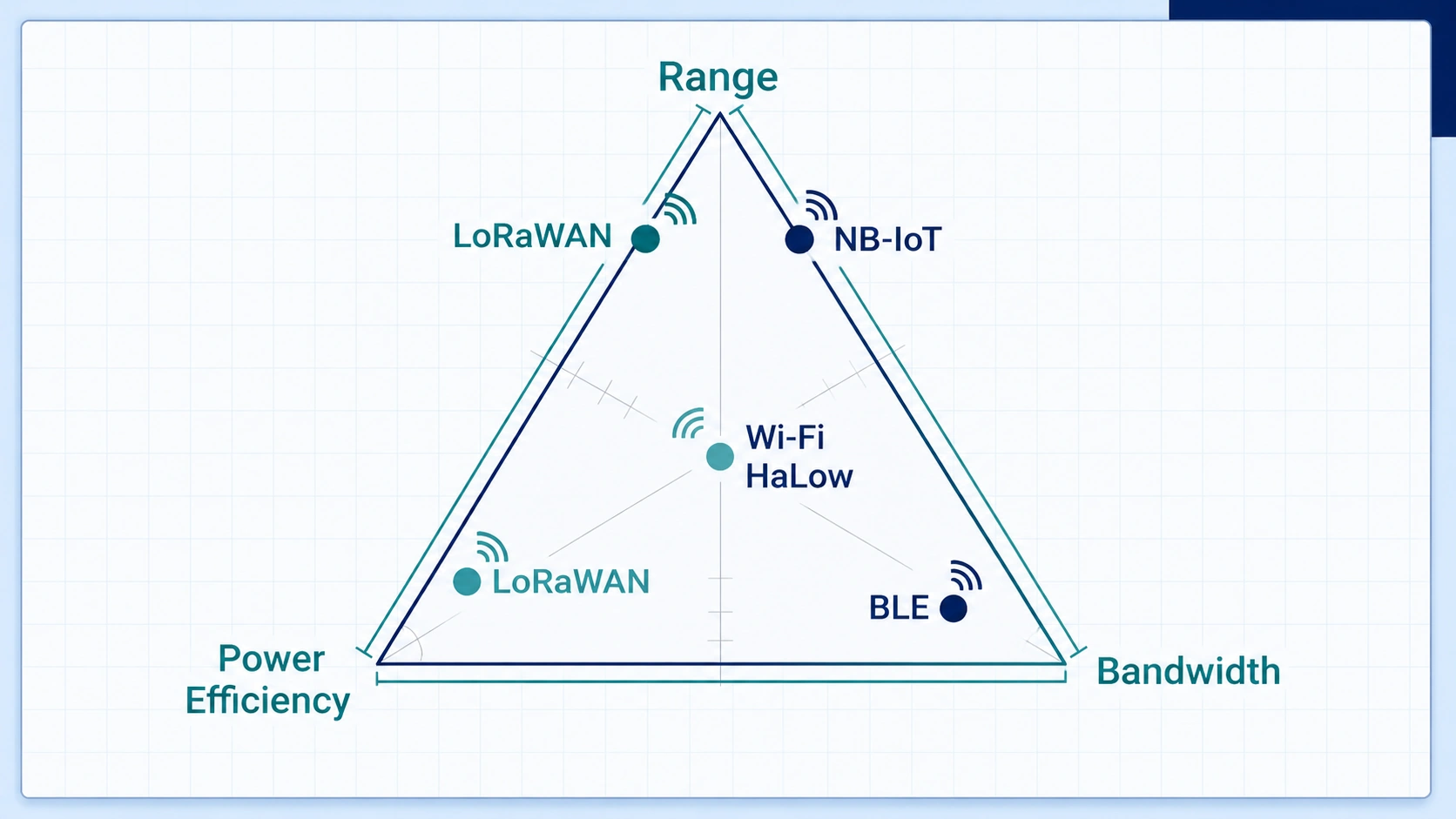
Every wireless protocol lives somewhere on a triangle bounded by range, power draw, and bandwidth, and pushing hard in one direction costs you in the other two.
BLE
BLE sits at the short-range, low-power, moderate-bandwidth corner. It reaches maybe 10 to 100 meters depending on obstacles and antenna design, sips power in the microamp range during idle states, and can move enough data for sensor readings, firmware chunks, or audio at a pinch. That makes it the default for wearables, smart locks, and anything that needs a phone app to talk to it at close range.
LoRaWAN
LoRaWAN flips the triangle. It trades bandwidth almost entirely for range and power efficiency, pushing kilometers in rural, line-of-sight conditions and still managing a kilometer or more through urban clutter, at data rates measured in a few kilobits per second. That's fine if your payload is a GPS coordinate and a battery voltage reading once every ten minutes. It's useless if you need to push a photo or a firmware update of any real size.
NB-IoT
NB-IoT occupies a different niche again. It rides on existing cellular infrastructure, so your range is effectively "wherever the carrier has coverage," which in most of the world means everywhere already, with none of the gateway deployment LoRaWAN demands. Power consumption is higher than LoRaWAN in active transmission but still low enough for multi-year battery life if your device sleeps aggressively between reports. Bandwidth lands somewhere between BLE and LoRaWAN, enough for structured telemetry but not for anything media-heavy.
Wi-Fi HaLow
Wi-Fi HaLow is the newer entrant worth taking seriously in 2026. Built on the 802.11ah standard, it operates in the sub-1GHz band, which gives it far better wall penetration and range than classic Wi-Fi, commonly 1 kilometer outdoors and several hundred meters through industrial structures, while still delivering hundreds of kilobits to a few megabits per second. That combination didn't really exist before: real bandwidth at LoRaWAN-like range, using IP networking your existing software stack already understands. The cost is a power budget closer to Wi-Fi than to LoRaWAN, so it suits mains-powered or solar-buffered nodes better than coin-cell sensors.
A Quick Mental Model
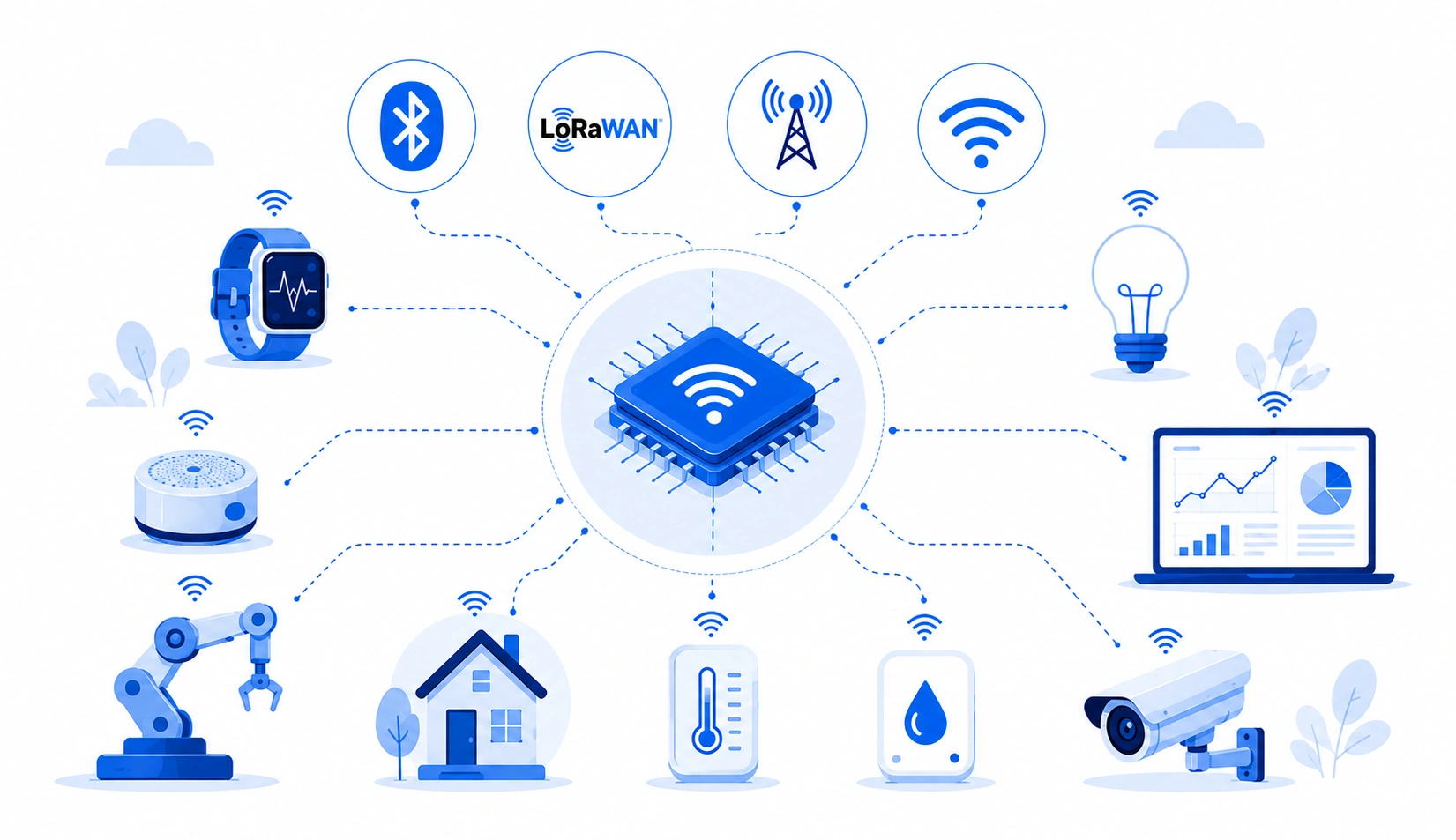
If you remember nothing else: BLE is for a device that talks to a phone. LoRaWAN is for a sensor that whispers a small amount of data very far. NB-IoT is for a sensor that needs cellular reach without deploying your own infrastructure. Wi-Fi HaLow is for a device that needs both real bandwidth and real range, and can afford slightly more power to get it.
What Certification and Carrier Costs Actually Look Like
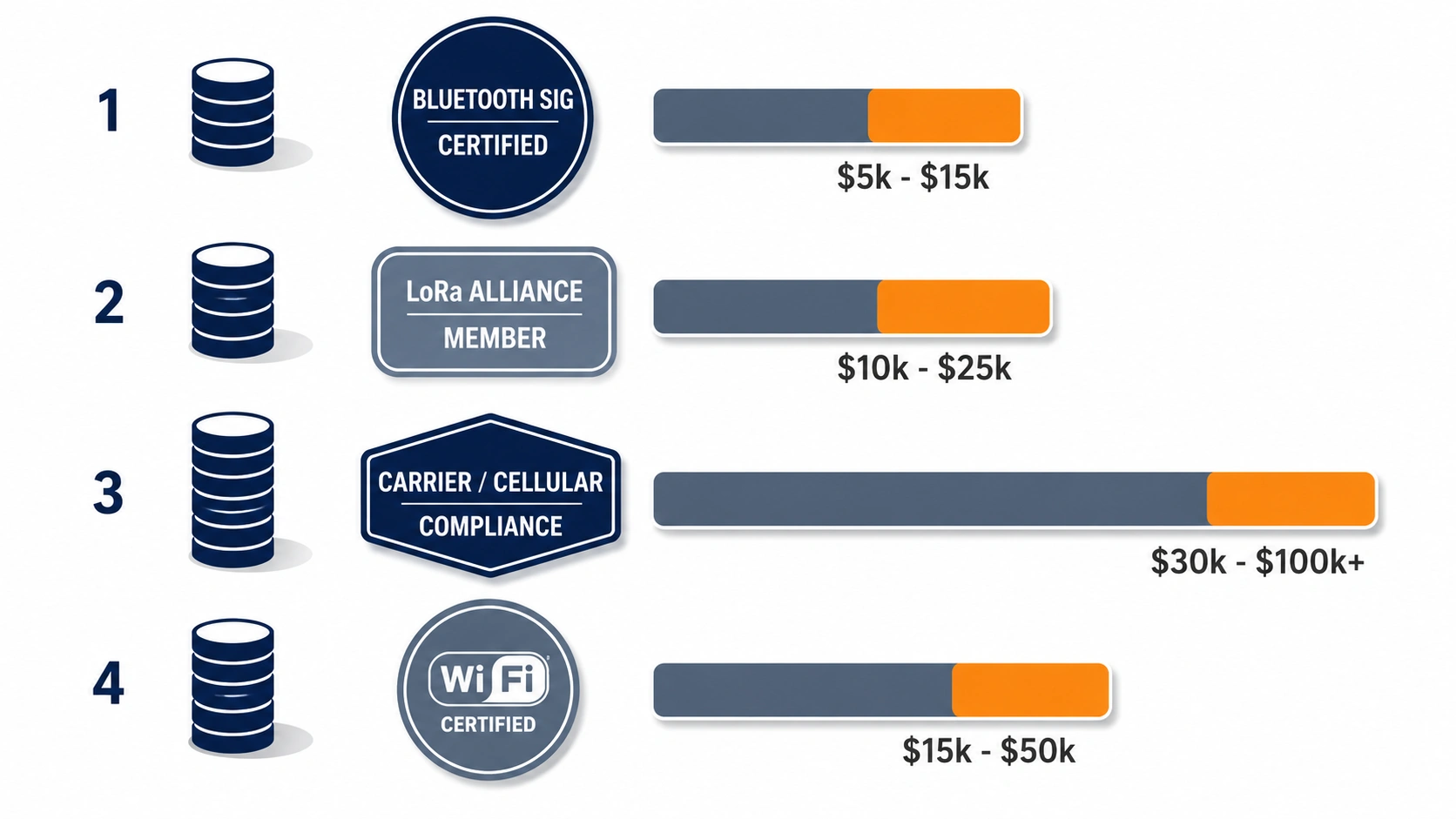
The spec sheet trade-offs get all the attention in early architecture discussions, but the line item that quietly reshapes a roadmap is certification and ongoing carrier cost, and it varies enormously across these four protocols.
BLE
BLE certification runs through the Bluetooth SIG. You'll pay a qualification fee based on your company size and product tier, typically a few thousand dollars per product listing, plus whatever radio module certification your chipset vendor already carries if you're not designing your own RF front end. Most teams using a pre-certified module (Nordic, ESP32-based BLE chips, and similar) inherit most of the regulatory work and only need to handle end-product listing. It's the cheapest and fastest path to market of the four.
LoRaWAN
LoRaWAN has no single certifying body in the same sense; the radio itself typically clears regional regulations (FCC, ETSI, and similar) through your module vendor, and LoRa Alliance certification for network compatibility is optional in many deployments, more relevant if you're selling into someone else's existing network rather than running your own gateways. The real cost here isn't certification, it's infrastructure: gateways aren't free, and if you're not piggybacking on a public network like The Things Network or a carrier's LoRaWAN rollout, you're budgeting for gateway hardware and backhaul at every site.
NB-IoT
NB-IoT is the expensive one to get wrong. Beyond standard regulatory certification, you need carrier certification for every network operator you intend to run on, and that process can take months and real money, especially if you're targeting multiple countries with different carriers. On top of that sits a recurring per-device data plan, often small per unit but multiplied across a fleet of thousands, it adds up into a real operating cost line that LoRaWAN and BLE don't have.
Wi-Fi HaLow
Wi-Fi HaLow, being an IEEE 802.11 standard, follows familiar Wi-Fi Alliance certification patterns, and as of 2026 the ecosystem of pre-certified HaLow modules has grown enough that most product teams aren't doing ground-up RF certification themselves. There's no carrier fee since you're running your own access points, but you are back to owning infrastructure, similar to LoRaWAN's gateway story, except HaLow access points do double duty as your local IP network backbone.
The practical takeaway: BLE and Wi-Fi HaLow front-load cost into hardware and infrastructure you control; NB-IoT front-loads it into carrier relationships and back-loads it into recurring data plans; LoRaWAN sits in between, cheap to certify but not free to deploy at scale unless you're riding on someone else's network.
Battery Life, Protocol Combinations, and Where Each One Wins in the Real World
Battery life is where the abstract trade-off triangle turns into a number a customer will actually see on a spec sheet, and the gap between protocols is bigger than most first-time IoT teams expect.
BLE
A BLE sensor beaconing every few seconds on a coin cell can run a year or more, because the radio spends almost all its time asleep and wakes for milliseconds at a time. Stretch that reporting interval and BLE can push past two years on the same cell.
LoRaWAN
LoRaWAN devices reporting infrequently, say once every fifteen minutes to a few times an hour, routinely hit five to ten years on a single set of AA lithium cells, because the transmit bursts are short and the sleep current between them is vanishingly small. This is the protocol's real superpower for field deployments where a truck roll to swap batteries costs more than the sensor itself.
NB-IoT
NB-IoT batteries drain faster than LoRaWAN's under similar reporting schedules because cellular attach and data transmission simply cost more energy per byte, but with Power Saving Mode and eDRX configured correctly, two to five years is realistic for a device reporting a handful of times per day. Push the reporting frequency up and that number falls quickly, since NB-IoT wasn't built for high duty cycles.
Wi-Fi HaLow
Wi-Fi HaLow is the one where "battery life" needs an asterisk. It can run on battery for months in low duty-cycle configurations, but it's not going to touch LoRaWAN's multi-year field life at any real bandwidth usage. Most HaLow deployments in 2026 are mains-powered, solar-assisted, or accept a battery service interval measured in months rather than years, in exchange for the bandwidth and IP connectivity LoRaWAN can't offer.
This is exactly why combining protocols on a single product has become standard practice rather than an edge case. A common pattern: BLE handles device provisioning and configuration through a phone app at setup time, since nobody wants to configure a LoRaWAN device over a serial cable in the field, while LoRaWAN carries the ongoing sensor data once the device is deployed and the phone walks away. Another pairing shows up in asset trackers, where BLE beacons handle fine-grained indoor positioning within a warehouse while NB-IoT or LoRaWAN reports coarse location once the asset leaves the building. Wi-Fi HaLow increasingly appears alongside BLE too, using BLE for low-power presence detection and HaLow for the video or high-bandwidth payload once something is worth transmitting.
Logistics
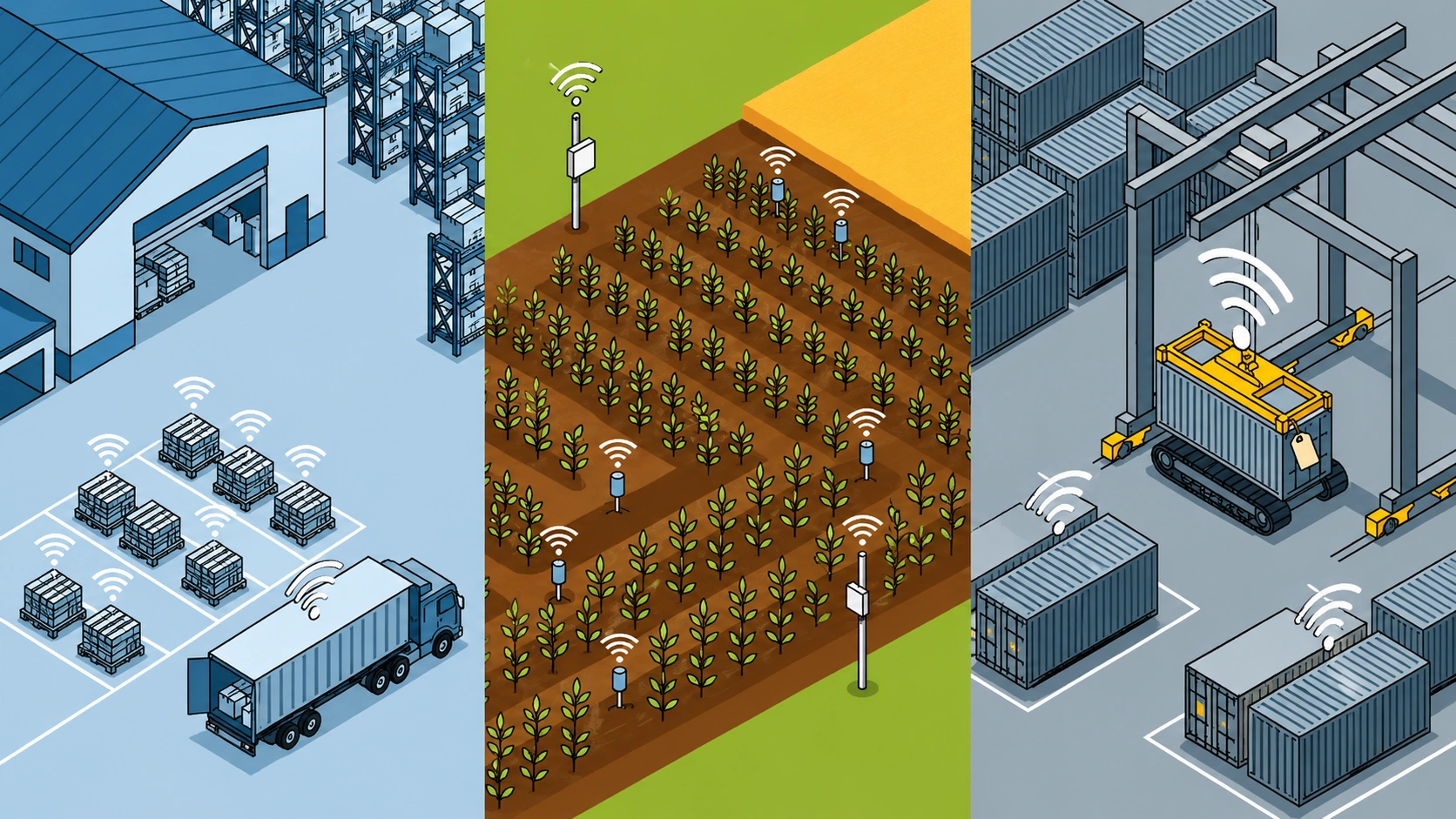
In logistics, this plays out as BLE tags inside a facility handing off to LoRaWAN or NB-IoT trackers once a container leaves the yard, giving continuous visibility without draining a battery designed for a multi-year deployment.
Agriculture
In agriculture, LoRaWAN dominates soil moisture and irrigation sensing across large acreage where gateway coverage is cheap to establish and cellular signal may be patchy anyway, while Wi-Fi HaLow is gaining ground for barn and greenhouse monitoring where higher-resolution camera or environmental data needs real bandwidth over a few hundred meters.
Asset Tracking
Asset tracking for high-value equipment tends to reach for NB-IoT specifically because it works the moment the asset crosses a border or leaves a region with no LoRaWAN gateway infrastructure at all, trading a recurring data bill for zero deployment effort.
Bringing It Together
There's no version of BLE vs. LoRaWAN vs. NB-IoT vs. Wi-Fi HaLow that ends with one universal winner, and that's the actual point of this framework. BLE wins when your device talks to a phone at close range and needs to sip power for years. LoRaWAN wins when you need to cover kilometers on a tiny payload and don't mind owning a gateway. NB-IoT wins when you need guaranteed cellular reach without building infrastructure and can absorb a recurring data cost. Wi-Fi HaLow wins when you need real bandwidth at long range and can accept a shorter battery cycle in exchange. Most serious 2026 products end up combining two of these rather than betting everything on one, and that decision needs to happen early, because it shapes your hardware BOM, your certification timeline, and your total cost of ownership for years after launch.
Getting this wrong is expensive to fix after tooling is committed. Not sure which connectivity stack fits your product? Book a free architecture consultation with Bluepixel, and we'll help you map your range, power, and bandwidth requirements onto the protocol stack that actually fits your deployment, not just the one that's trending this quarter.
Share Article
Linkedin
Facebook
Copy link
Recent Blogs



August 19, 2026
Share Article
Linkedin
Facebook
Copy link