

Skip to main content Scroll Top

NB-IoT

left_bg_new
right_bg_new
Licensed Spectrum. Carrier-Grade. Basement Deep.
Cellular Coverage That Reaches Where Nothing Else Can.
We engineer, certify, and deploy production-grade NB-IoT systems, from smart meters buried three floors underground to industrial sensors spanning national carrier networks. Licensed spectrum reliability. Decade-long battery endurance. Carrier SLA guarantees that unlicensed protocols simply cannot match.

177+

Operators with Live NB-IoT Networks

20dB

Coverage Gain Over Standard LTE

15 yr

Battery Life on a Single Cell

nb-iot-services-vector

The Only LPWAN with a Carrier-Grade SLA and a Decade of Battery Life

NB-IoT isn't just another connectivity option. It's 3GPP-standardised cellular infrastructure operating on licensed spectrum designed from the ground up for the hardest IoT challenge: connecting millions of low-power devices in places other protocols can't reach, with reliability guarantees that unlicensed bands can't offer.
20 dB Deep Indoor Penetration
Signals punch through multiple concrete floors, basement meter rooms, underground car parks, and steel-walled enclosures. NB-IoT reaches devices buried where Wi-Fi, BLE, and unlicensed LPWAN protocols fade to silence.
10–15 Year Battery Endurance
Power Saving Mode (PSM) and extended Discontinuous Reception (eDRX) slash current draw to single-digit microamps. Deploy a water meter today and replace its battery well into the 2030s. That's the economics of true scale.
100,000+ Devices Per Cell
Massive Machine-Type Communication at its purest. A single NB-IoT cell handles tens of thousands of endpoints reporting hourly, the density required for city-wide metering, national sensor grids, and continent-spanning asset fleets.
Licensed Spectrum Reliability
No interference from garage door openers or baby monitors. NB-IoT operates on licensed LTE bands with carrier-managed QoS, mutual authentication, and regulatory protection - the reliability tier that utility boards and regulators demand.
177+ Carriers, Global Roaming
Leverage existing LTE infrastructure across 177+ operator networks worldwide. No gateway deployment, no spectrum licensing, no private infrastructure capex. Your devices connect the moment they power on, anywhere with cellular coverage.
5G-Native, Future-Guaranteed
NB-IoT is a 5G mMTC technology per 3GPP Release 15 and beyond. Carriers have committed support through 2035+. When you outgrow NB-IoT throughput, the migration path to 5G RedCap and eRedCap is already standardised.

Market Intelligence & Growth Trajectory

The NB-IoT Market in 2026: A $2.6 Billion Ecosystem Accelerating Fast
NB-IoT has transitioned from carrier trials to national-scale production deployments. These numbers represent the economic engine behind every smart city mandate, every utility modernisation programme, and every enterprise IoT strategy built on licensed spectrum.
$2.6B
Global NB-IoT Market Size (2025)
Forecast to exceed $22B by 2030 at ~35% CAGR
177+
Mobile Operators with Live NB-IoT
Deployed across every inhabited continent - coverage expanding monthly
4.5B
Cellular IoT Connections (2025)
Approaching 8 billion by 2031 - NB-IoT commanding the massive IoT tier
40%+
NB-IoT Revenue from Utilities & Metering
Smart water, gas & electricity meters are the dominant deployment category
NB-IoT Through the 3GPP Releases: From Cat-NB1 to 5G-Native
Every 3GPP release adds new capabilities and performance headroom to NB-IoT and we architect every deployment with forward compatibility so your infrastructure gains value as the standard evolves.

Rel-13

2016

NB-IoT Born — Cat-NB1

3GPP introduced NB-IoT as a clean-slate LPWAN standard within LTE. 200 kHz bandwidth, three deployment modes (standalone, guard band, in-band), 20 dB coverage enhancement over LTE, and support for massive device density - the foundation of carrier-grade IoT.

Rel-14

2017

Cat-NB2 — Speed & Mobility

Peak throughput quadrupled with multi-carrier operation and higher Transport Block sizes. Positioning support via OTDOA added location awareness. Connected-mode mobility enabled cell handover, opening NB-IoT to tracking and logistics applications for the first time.

Rel-15

2019

5G Integration — mMTC

NB-IoT officially became a 5G technology, fulfilling the massive Machine-Type Communication (mMTC) requirement of IMT-2020. TDD support expanded spectrum options. Wake-up signaling dramatically reduced power consumption for infrequent-reporting devices.

Rel-16

2020

Enhanced Mobility & Multicast

SC-PTM multicast enabled simultaneous firmware delivery to thousands of devices. Small cell support and enhanced power-saving algorithms refined performance. NB-IoT became viable for dense urban and private network deployments.

Rel-17

2022

Non-Terrestrial Networks (NTN)

Satellite-based NB-IoT standardised for the first time, enabling coverage over oceans, deserts, and polar regions via LEO satellite constellations. Reduced capability NR devices (RedCap) introduced alongside, signaling the mid-tier 5G migration pathway.

Rel-18

2024

5G-Advanced & eRedCap

Enhanced RedCap targets 10 Mbps at minimal power, positioning as the eventual NB-IoT successor for higher-throughput use cases. Extended eDRX cycles push battery life even further. NB-IoT solidified as the long-term massive IoT anchor within the 5G-Advanced ecosystem.

NB-IoT Doesn't Just Connect Devices. It Delivers Carrier-Grade Intelligence at National Scale.
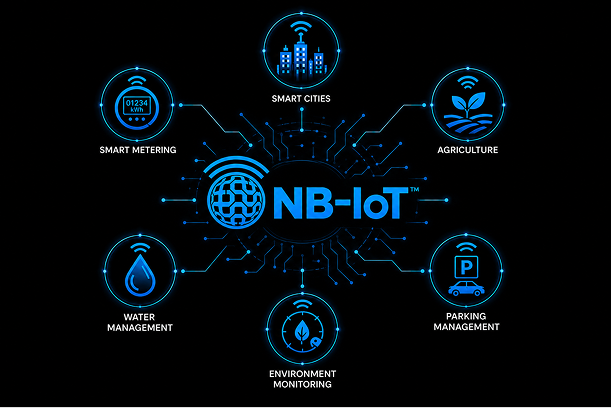
From water meters buried beneath city streets to health monitors strapped to a patient's wrist — NB-IoT is the invisible cellular backbone powering operational transformations where reliability isn't optional and coverage gaps are unacceptable.

Utilities & Smart Metering

Smart metering accounts for over 40% of all NB-IoT revenue worldwide making it the single largest deployment vertical. Water, gas, and electricity meters transmit consumption data from basement meter rooms and underground vaults where no other wireless technology reliably reaches. Carriers offer dedicated NB-IoT metering tariffs that make per-device connectivity cheaper than a single annual truck roll. The payback period? Measured in months, not years. And with regulatory mandates accelerating smart meter rollouts across Europe, Asia-Pacific, and the Middle East, this segment alone is projected to sustain double-digit growth through 2032.

Key Use Cases We Deliver

Smart Cities & Environmental Intelligence

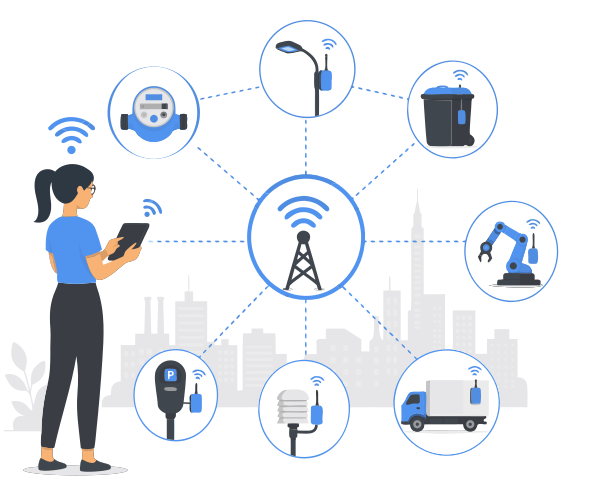
NB-IoT is becoming the nervous system of smart city infrastructure precisely because it rides existing carrier networks no private gateway deployment, no spectrum licensing, no RF site surveys. Municipal governments deploy tens of thousands of NB-IoT sensors for air quality monitoring grids, smart parking guidance systems, waste bin fill-level alerts, street light controllers, and flood-level early-warning networks. The deep indoor coverage means parking sensors buried in concrete work flawlessly. The carrier QoS means emergency flood alerts arrive with guaranteed latency. Asia-Pacific leads adoption, with China alone operating millions of NB-IoT-connected city devices.

Key Use Cases We Deliver

Industrial IoT & Condition Monitoring

NB-IoT reaches the deep interiors of factories, refineries, and warehouses where Wi-Fi fails and wiring is prohibitively expensive. Vibration sensors on rotating machinery predict bearing failures weeks in advance. Gas detectors report hazardous concentration spikes with carrier-grade delivery assurance. Energy sub-meters track consumption per production line, per shift, per machine — delivering the granular visibility that operational excellence teams need to eliminate waste. And because NB-IoT uses existing cellular infrastructure, you don't install a single gateway on the factory floor.

Key Use Cases We Deliver

Asset Tracking & Supply Chain Visibility

Since 3GPP Release 14 introduced connected-mode mobility, NB-IoT has become a viable cellular tracking technology particularly for slow-moving, high-value assets that need years of battery life rather than real-time GPS precision. Pallet-level trackers in cold-chain logistics report temperature and location at every warehouse handoff. Returnable container tags monitor cycle times and detect shrinkage across distribution networks. The combination of carrier roaming, deep indoor penetration, and multi-year battery life makes NB-IoT uniquely suited for assets that disappear into warehouses, shipping containers, and underground storage exactly where GPS and Wi-Fi lose signal.

Key Use Cases We Deliver

Healthcare & Remote Patient Monitoring

NB-IoT is enabling a new generation of remote health monitoring that operates outside hospital Wi-Fi networks and beyond BLE range. Wearable cardiac monitors transmit ECG data through building walls that defeat shorter-range protocols. Elderly care pendants deliver SOS alerts from inside reinforced-concrete apartments. Pharmaceutical cold-chain loggers ensure vaccine and insulin shipments maintain temperature integrity from depot to rural clinic. The carrier network means these devices work anywhere a phone gets signal — no hub, no pairing, no patient-managed connectivity. Healthcare is the fastest-growing NB-IoT use case category outside of metering.

Key Use Cases We Deliver

Agriculture & Water Resource Management

While LoRaWAN dominates private farm networks, NB-IoT excels in agriculture scenarios where carrier coverage already exists and the deployment needs to span hundreds of kilometres without installing a single gateway. Soil moisture sensors across sprawling irrigation districts report to the cloud via existing cell towers. Water table level monitors in bore wells track aquifer depletion in real time. Livestock health tags transmit biometric data from grazing areas far beyond any private network's reach. For government-backed agricultural IoT programmes deploying at state or national scale, NB-IoT's zero-infrastructure approach dramatically reduces rollout timelines.

Key Use Cases We Deliver

Infrastructure Monitoring & Worker Safety

Bridges, tunnels, dams, and high-rise structures require continuous monitoring over decades and NB-IoT sensors deliver exactly that. Tilt gauges on bridge piers, crack sensors in tunnel linings, and vibration monitors on dam walls transmit structural health data without any on-site power or networking infrastructure. Construction sites deploy NB-IoT for automated worker headcounts, equipment geo-fencing, and environmental compliance logging. The carrier network eliminates the need for temporary IT infrastructure on every job site and the 15-year battery life means structural sensors outlast the construction teams who installed them.

Key Use Cases We Deliver

We Don't Hand You a Module and Wish You Luck. We Deliver the Complete Cellular IoT Stack.
Most NB-IoT vendors stop at the module datasheet. We go from chipset evaluation and power profiling all the way through carrier certification, cloud analytics, mobile apps, and billing system integration, because a module without a platform is just a SIM card draining prepaid credit into silence.
Layer 1
Module & Firmware
Layer 2
Carrier & Connectivity
Layer 3
Cloud & Data Platform
Layer 4
Applications & AI

How We Take You from Evaluation to Nationwide

No Carrier Confusion. No Certification Delays. Just Working NB-IoT, Deployed Right.

01

Strategy & Carrier Assessment

We start with your operational problem and not a module catalogue. Coverage mapping, indoor propagation analysis, carrier tariff comparison, NB-IoT vs LTE-M vs LoRaWAN evaluation, and an architecture decision document your team can take to the board.

02

Module Selection & Firmware PoC

Chipset benchmarking, custom device firmware, PSM/eDRX power profiling, antenna matching, eSIM provisioning, and carrier pre-certification testing. You get a device reporting real data over a live carrier network not a simulation.

03

Cloud Platform & Application Build

AWS IoT Core or Azure IoT Hub integration, CoAP/LwM2M bridges, real-time dashboards, mobile apps, billing system connectivity, alerting engines, and API-first architecture. Everything load-tested before a single device ships.

04

Pilot & Carrier Certification

Controlled deployment at a single site. We instrument everything - message delivery ratio, latency, power consumption, coverage depth, handover reliability, while running formal carrier device certification in parallel.

05

Nationwide / Multi-Carrier Rollout

Mass device provisioning, eSIM lifecycle management, OTA firmware delivery, operational monitoring dashboards, carrier SLA tracking, and field team training. Your devices go live at scale with zero-touch activation.

06

Managed Support & 5G Migration Path

Post-launch SLA-backed support. Firmware patches, security updates, feature sprints, carrier relationship management, and a documented migration roadmap for 5G RedCap / eRedCap when higher throughput becomes necessary.
What's Coming Next And Why Every NB-IoT Deployment Should Be Built for It
NB-IoT is entering its maturity phase, and the 3GPP roadmap ahead compounds its value. We architect every system with an upgrade trajectory to these near-horizon capabilities, so your investment appreciates instead of depreciates.
2026
5G RedCap Modules Hit Mass Market
RedCap-enabled modules from Qualcomm, MediaTek, and Sequans are shipping commercially. For NB-IoT deployments that eventually need higher throughput, RedCap offers a clean 5G upgrade path at module cost approaching LTE Cat-1 levels.
2026–2027
eRedCap Bridges NB-IoT and 5G NR
Enhanced RedCap from 3GPP Release 18 targets 10 Mbps at NB-IoT-class power budgets. This creates a seamless migration tier - your device hardware stays, only the modem module upgrades when the use case demands more bandwidth.
2026–2028
Satellite NB-IoT Goes Commercial
3GPP Release 17 NTN standardisation is translating into commercial LEO satellite NB-IoT services. Devices deployed today on terrestrial networks will gain satellite fallback, extending coverage to oceans, deserts, and polar regions without hardware changes.
2027–2030
AI-Driven Network Optimisation (NWDAF)
5G-Advanced introduces Network Data Analytics Function, enabling AI/ML-driven traffic prediction, anomaly detection, and SLA assurance at the network level. Your NB-IoT devices benefit from smarter scheduling, reduced latency, and predictive coverage optimisation without firmware changes.

Cellular LPWAN Technology Comparison

NB-IoT vs. Every Other IoT Connectivity Protocol
Selecting the right technology or the right hybrid combination is the first architectural decision that determines whether your project scales or stalls. Here's how NB-IoT stacks up against every alternative.
ParameterNB-IoTLTE-MLoRaWANSigfox5G RedCapWi-Fi
Range1–10 km (deep indoor)1–10 km2–15 km3–50 km1–5 km50–100 m
Indoor Penetration+20 dB (exceptional)+15 dBModerateModerateGoodPoor
Battery Life10–15 years5–10 years5–15 years5–10 years2–5 yearsHours–Days
Peak Data Rate26–66 Kbps588 Kbps – 1 Mbps0.3 Kbps–1 Mbps100–600 bps10–220 Mbps1+ Gbps
SpectrumLicensed (LTE)Licensed (LTE)Licence-Free (ISM)Licence-FreeLicensed (5G NR)ISM 2.4/5/6 GHz
Devices/Cell100,000+~10,00010,000+ / gateway~1M / base~1,000~250
Recurring FeesPer-SIM (very low)Per-SIMNonePer-device/yearPer-SIMNone
Mobility SupportLimited (Rel-14+)Full handoverNoneNoneFull 5G mobilityLimited
Best ForDeep indoor meteringMobile + voice IoTPrivate sensor netsSimple uplinkMid-tier 5G IoTHigh throughput

* Production-grade IoT architectures often combine NB-IoT with LoRaWAN, LTE-M, or 5G RedCap depending on coverage, throughput, and cost requirements. We help you design the optimal hybrid stack.

Every Question Your Procurement Team Will Ask, Answered.
We've navigated these questions across hundreds of cellular IoT evaluations. If yours isn't below, that's exactly what the free strategy session is for.

NB-IoT is a 3GPP-standardised narrowband cellular technology that operates within a 200 kHz slice of licensed LTE spectrum. Unlike regular LTE designed for smartphones, NB-IoT is purpose-built for massive IoT, delivering 20 dB deeper indoor coverage, 10–15 year battery life, and support for over 100,000 devices per cell at a fraction of full LTE module cost. It can be deployed in-band within existing LTE carriers, in the guard band, or as a standalone carrier.

NB-IoT uses repetition coding to boost link budget by 20 dB over standard LTE. In practice, this means signals reliably penetrate multiple concrete floors, underground meter rooms, basement car parks, and industrial enclosures with steel walls. This is the core reason utilities have chosen NB-IoT over every alternative for smart metering, as meters are almost always in the hardest-to-reach locations in a building.

NB-IoT is the right choice when you need carrier-grade QoS, deep indoor penetration, zero private infrastructure, and licensed-spectrum interference immunity, especially for utility metering and regulated industries. LoRaWAN is ideal when you need a private network with zero recurring fees and maximum rural range. Many enterprises deploy both: NB-IoT for metering and deep indoor, LoRaWAN for wide-area environmental and agricultural sensing.

No. NB-IoT is officially a 5G technology, classified as 5G mMTC since 3GPP Release 15. Major carriers globally have committed to NB-IoT support through at least 2035. When higher throughput is eventually required, the standardised migration path runs through 5G eRedCap, which targets NB-IoT-class power consumption at 10 Mbps speeds. Your NB-IoT investment is protected for the long haul.

Since Release 14 (Cat-NB2), NB-IoT supports connected-mode mobility with cell handover. It’s well-suited for slow-moving asset tracking pallets, containers, fleet trailers, where hourly location updates and multi-year battery life matter more than real-time GPS precision. For high-mobility tracking requiring continuous GPS and voice, LTE-M is the better cellular LPWAN choice.

Ready to Deploy Cellular IoT
That Reaches Every Basement, Every Border?
Whether you're metering a million water connections, monitoring factory equipment three floors underground, or tracking cold-chain assets across continents, your NB-IoT journey starts with a 30-minute architecture conversation. No pitch deck. Just engineering.