



Education
50+
Educational institutions served across India, UAE, and Southeast Asia
95%
Average reduction in manual attendance processing effort post-deployment
80%
Reduction in library book loss and unaccounted asset write-offs
Sector Overview
How Technology Is Reshaping Campus Operations
K–12 Schools
Universities & Colleges
Coaching Institutes
Corporate Training Centres
Government Institutions
International Schools
A mid-size university might manage 15,000 students, 2,000+ staff, 80,000+ library items, and thousands of shared equipment pieces, all in motion, across dozens of buildings, every single day.
Regulatory bodies, accreditation frameworks, and safety authorities are increasingly requiring institutions to demonstrate documented attendance records, asset accountability, and emergency preparedness capability.
The Operational Gap
Where Campus Management Breaks Down Without Connected Technology
Roll calls consume 5–10 minutes of every class period. Proxy attendance is an open secret. Records are inconsistent across departments, making compliance reporting and parent communication unreliable. The data exists, but its integrity doesn't hold up to scrutiny.
Book issue and return processes are slow and error-prone. Items go missing without triggering any audit trail. Shelf locations are approximate at best. Stock reconciliation takes days and is typically outdated by the time it's complete. Librarians spend most of their time on logistics, not curation.
Laptops, projectors, lab equipment, AV hardware - institutions write off 8–15% of their movable asset base annually because there is no reliable way to know what is where, who last used it, or when it last moved. Manual asset registers are out of date the moment they're created.
When a fire alarm sounds or an emergency occurs, institutions need to know where every student and staff member is, immediately. Without real-time location intelligence, mustering procedures rely on paper lists and manual counts that take 15–25 minutes and are frequently inaccurate.
Lecture halls are booked but empty. Labs are over-subscribed. Common areas are overcrowded at certain hours. Without occupancy data, infrastructure investment decisions around new buildings, renovation priorities, scheduling changes are made on assumptions rather than evidence.
Many institutions have already deployed point solutions, a standalone attendance system, a basic library software, a separate access control setup that operate independently, require separate logins, and never share data. The result is more systems, more overhead, and still no unified operational view.
What We Deliver
Technology Capabilities We Deploy in Education Environments
End-to-end visibility of institutional assets — from IT hardware and AV equipment to lab instruments and furniture. Zone-based location awareness, movement audit trails, exit alerts, and automated inventory reports replace manual asset registers and periodic audits.
RFID
BLE Tags
Zone Alerts
Audit Logs
RFID-based library systems that automate book issue, return, and shelf-level location tracking. Anti-theft detection at exit gates, self-issue kiosks, overdue notification workflows, and real-time inventory dashboards without requiring manual intervention from library staff for routine transactions.
UHF RFID
Anti-Theft Gates
Self-Issue
Inventory Reports
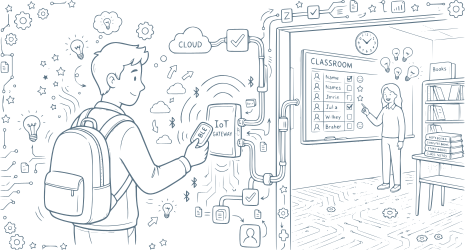
Passive BLE or RFID-based attendance capture that records student and staff presence automatically as they enter classrooms, labs, or campus zones without roll calls, manual registers, or any action from the student. Records flow directly into academic and HR systems via API integration.
BLE Passive
RFID Cards
SIS Integration
Parent Alerts
Real-Time Location Systems (RTLS) using BLE anchors and wearable tags to deliver zone-level occupancy awareness across campus. Emergency mustering reports, unauthorised zone alerts, crowd density heat maps, and historical movement logs for safety audits and compliance requirements.
BLE RTLS
Emergency Muster
Occupancy Maps
Zone Alerts
A single, cloud-hosted operational view aggregating all tracking data streams including assets, library, attendance, and occupancy, accessible by administrators, department heads, and security teams from any device. Role-based access ensures the right data reaches the right stakeholders without exposing sensitive records broadly.
AWS Cloud
Role Access
Mobile App
Real-Time
Our tracking infrastructure doesn’t sit in isolation. We integrate with Student Information Systems (SIS), ERP platforms, HR software, and payroll systems via APIs and webhooks, so attendance data, asset records, and library transactions flow directly into your existing systems of record without manual exports or duplicate entry.
API-First
Webhooks
SIS Connectors
ERP Sync
Technology Stack
The Technologies We Deploy in Education Environments
Application Scenarios
How Our Capabilities Apply Across Institution Types
K–12 Schools
Attendance
Library
Safety
- Touchless classroom attendance no roll calls, records generated automatically at entry
- Automated parent SMS or app notification when a child is absent or leaves a defined zone
Reduction in time spent on attendance processing across all classes per day
Drop in library book loss within the first academic year post-deployment
Faster asset audit completion with full audit trail available on-demand
Universities & Colleges
RTLS
Multi-Building
ERP Integration
- Centralised multi-building library network with live inventory dashboard across all branches
- RTLS campus-wide people tracking for emergency mustering and zone compliance reporting
Campus-wide emergency headcount, compared to 15–25 minutes via manual mustering
Reduction in asset write-offs within the first full year of RFID tracking deployment
Faster library stock reconciliation with zero manual counting effort required
Coaching Institutes & Training Centres
Attendance
Compliance
Fee Management
- Automated real-time attendance capture at every batch session without manual effort
- Parent WhatsApp or app notification within minutes of a student being marked absent
- Attendance trend reports for early intervention when disengagement patterns emerge
Attendance record completeness — no missing sessions or disputed entries
Average time from session start to parent notification of absent student
Reduction in student drop-off rate after early-intervention alerts were introduced
Corporate Learning & Development Campuses
HR Integration
Safety Compliance
Asset Control
- Touchless attendance tied directly to HR systems — shift records updated without manual export
- Safety zone monitoring and lone worker alerts for industrial training environments
- Training equipment tracking across labs and shared facility areas with full custody trails
Regulatory audit coverage — all attendance and access records timestamped and stored
Reduction in equipment write-off and unaccounted asset incidents year-on-year
Manual data entry steps between attendance capture and payroll/HR system update
Industry Perspective
Where Education Technology Is Heading Over the Next Five Years
Now
RFID Library Systems Are Replacing Barcode Infrastructure Across the Region
2025 – 2027
Passive BLE Attendance Is Replacing Active Tap-Based Systems in Progressive Institutions
2025 – 2028
Campus Safety Compliance Is Driving Mandatory People-Tracking Investment
2026 – 2029
Unified Operational Dashboards Are Consolidating Fragmented Point Solutions
2027 – 2030
Space Utilisation Analytics Will Drive Infrastructure Planning Decisions
2028 – 2031
AI-Layered Analytics Will Convert Tracking Data Into Operational Intelligence
Industry Insights
Campus IoT Is No Longer Optional, It's Becoming the Standard
Libraries that still rely on barcode scanners and manual registers are operating with 1990s infrastructure. RFID book tracking with anti-theft gates and self-issue kiosks is now the baseline expectation in institutions across India, the UAE, and Southeast Asia.
While RFID card tapping remains common, the shift to passive BLE detection, where a student's presence is captured automatically as they enter a room without any action, is gaining rapid adoption in progressive institutions that want zero friction and zero proxies.
Post-pandemic regulatory pressure and insurance requirements are pushing institutions to implement real-time occupancy monitoring, emergency mustering systems, and documented headcount capability. RTLS is no longer just a convenience, it's becoming a liability-mitigation requirement.
Early adopters deployed separate systems for library, attendance, and assets, each with its own software, vendor, and data silo. The next wave is consolidation: one platform, one dashboard, one data layer across all campus tracking functions. Institutions that build integrated from the start will avoid costly rearchitecting later.
The next frontier for campus asset tracking isn't just knowing where something is, it's knowing when it will fail, how often it's actually being used, and which departments are underutilising what they've been allocated. AI-layered analytics on top of RFID/BLE data will drive procurement and maintenance decisions automatically.
The most forward-thinking universities are already building alumni learning subscriptions. As industries evolve every 3–5 years, formal institutions are becoming lifelong learning partners, not just 4-year stops on a career path, nurturing continuous growth and sustained professional success for graduates.
Technology Can Do for Your Institution?
- No commitment required
- Responded to within one business day by a solutions architect, not a sales representative