

Skip to main content Scroll Top

ESP-NOW

left_bg_new
right_bg_new
Wireless Communication → ESP-NOW
No Router. No Handshake. No Waiting. Just Data, in Milliseconds.
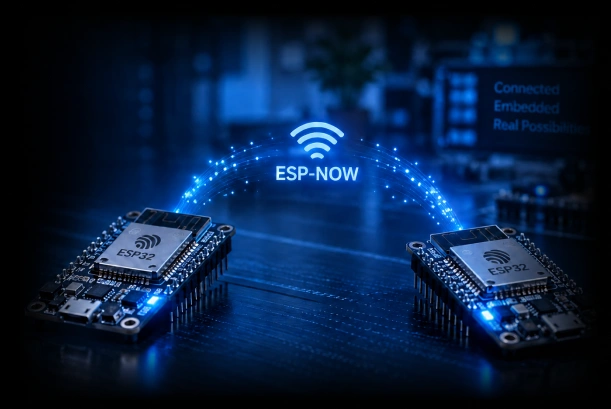
A pressure sensor wakes, sends a reading, and is back asleep before a Wi-Fi radio would have finished scanning for an access point. That is the entire premise of ESP-NOW Espressif's connectionless protocol that strips away DHCP, TCP/IP and association delays, and lets ESP32 devices talk directly to each other over raw Wi-Fi frames. We build the full stack around it: node firmware, power-budgeted hardware, encrypted peering, gateway bridges, OTA pipelines and the cloud layer that turns raw packets into decisions.

150+

IoT Deployments

12+

Industries Served

5M+

Devices Connected

What Is ESP-NOW and Why Do Engineers Reach For It When Wi-Fi Is Too Slow and BLE Is Too Small?

ESP-NOW is a connectionless wireless communication protocol developed by Espressif Systems for its ESP8266 and ESP32 families. It runs directly on the 802.11 physical layer using vendor-specific action frames, which means it borrows the Wi-Fi radio your device already has but discards everything that makes Wi-Fi slow to start. There is no access point to associate with, no DHCP lease to negotiate, no TCP session to establish, and no IP stack to traverse. Two devices exchange MAC addresses once, and from that point forward a packet leaves one radio and arrives at the other in a few milliseconds.
That single architectural decision changes the economics of a battery-powered sensor. A conventional Wi-Fi node may need several seconds to wake, scan, authenticate and reconnect before it transmits a single byte and every one of those seconds is drawn at full radio current. An ESP-NOW node wakes from deep sleep, transmits, confirms delivery and returns to sleep in a fraction of that window. Multiply that across a two-year deployment and the difference is not incremental; it decides whether the product runs on a coin cell or needs mains power.
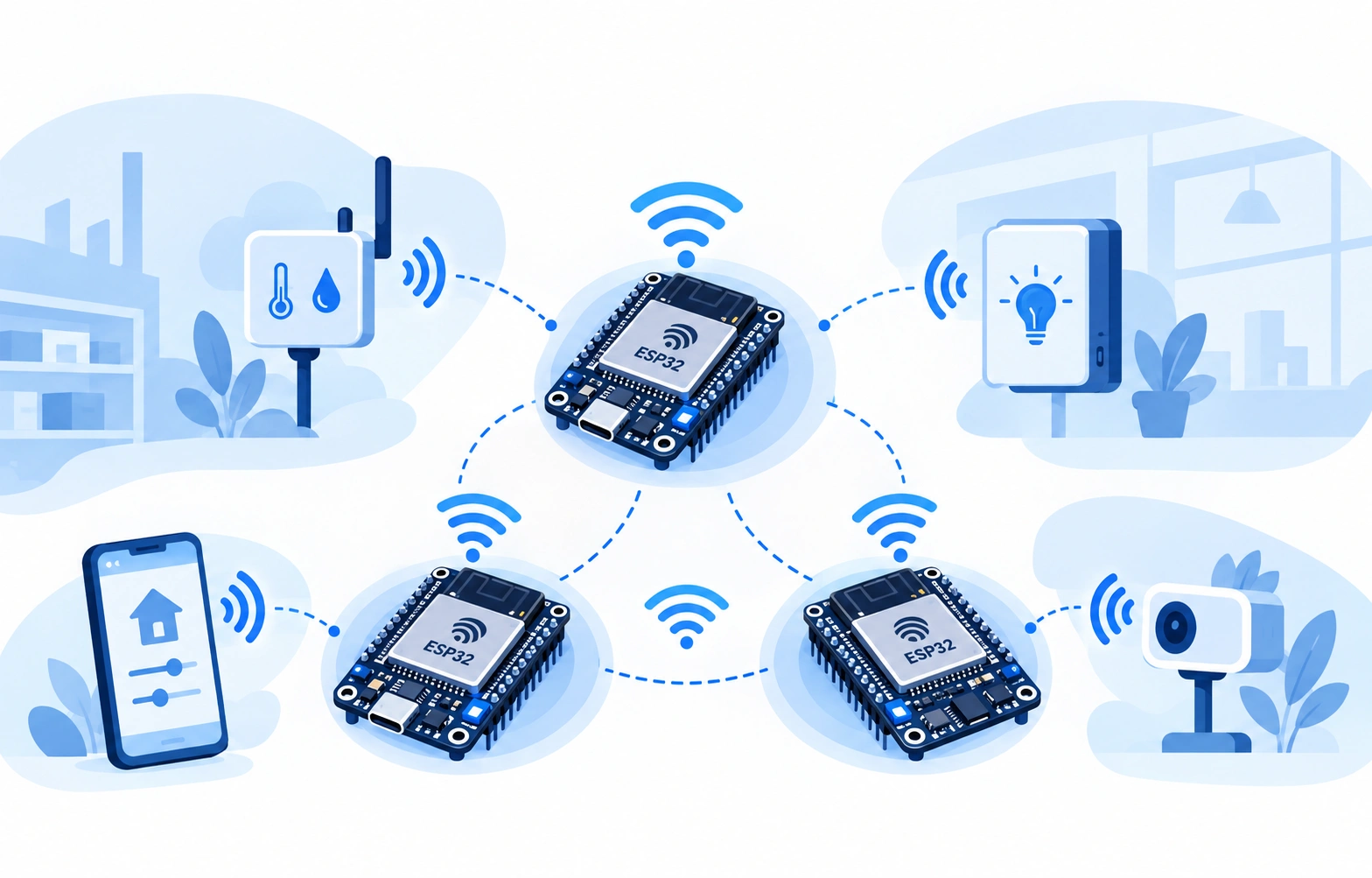
The protocol has matured well beyond its hobbyist reputation. Payloads expanded from 250 bytes to 1,470 bytes with ESP-NOW v2.0, encrypted unicast peering uses CCMP with paired master and local keys, and Long Range mode pushes line-of-sight links past the range most short-range protocols can reach. Paired with an ESP32 gateway that holds a simultaneous Wi-Fi or Ethernet uplink, ESP-NOW gives you a local, router-independent sensor fabric that still terminates cleanly in AWS IoT Core.
The honest framing matters here: ESP-NOW is not a replacement for BLE, LoRaWAN or full Wi-Fi. It is the right answer for a specific and very common shape of problem many low-cost nodes, small and frequent messages, tight latency, no dependence on site IT infrastructure. Knowing where that boundary sits is most of the value we bring to an architecture review.
Latency Measured in Milliseconds, Not Seconds
Because there is no association or IP negotiation, a packet moves peer-to-peer in single-digit milliseconds. That makes ESP-NOW viable for use cases Wi-Fi cannot serve machine interlocks, synchronised lighting scenes, remote triggers, emergency stop signalling and control loops where a two-second reconnect is a failed product.
The Radio Is Already In Your BOM
ESP-NOW runs on the same ESP32 silicon you are likely already specifying for Wi-Fi or Bluetooth. No second transceiver, no additional antenna path, no extra certification burden. A device can hold an ESP-NOW peer fabric and a Wi-Fi uplink on the same chip which is precisely how we build gateways.
Survives When the Network Doesn't
Router reboots, ISP outages, IT policy changes, guest-network isolation none of them touch an ESP-NOW link. For factory floors, construction sites, agricultural plots and any environment where you cannot rely on site Wi-Fi being present or permitted, this independence is often the deciding factor.
Deep Sleep That Actually Pays Off
The shorter the wake window, the longer the battery lasts. ESP-NOW compresses the entire transmit cycle into milliseconds, so duty-cycled nodes spend almost all their life in deep sleep. We model the full energy budget wake cost, transmit current, retry behaviour, self-discharge before hardware is frozen.
Encrypted Peer Links, Not Open Broadcast
ESP-NOW supports CCMP-encrypted unicast using a primary master key and per-peer local keys. We layer disciplined key provisioning, payload-level authentication, sequence numbering and replay protection on top, so a production deployment isn't relying on obscurity the way a demo project does.
Cheap Enough to Deploy Densely
ESP32-C3 and ESP32-C6 class modules sit at a price point that makes hundreds of nodes economically sane. When per-node cost stops being the constraint, you stop rationing sensors and start instrumenting properly which is where the operational insight actually comes from.

Adoption & Ecosystem Intelligence

The Numbers Behind the Espressif Ecosystem
ESP-NOW isn't a niche experiment it rides on one of the most widely shipped wireless MCU platforms in the industry. These figures shape how we scope, source and de-risk every deployment.
1B+
Espressif IoT chips shipped cumulatively
Crossed the one-billion milestone in 2023 and still climbing
1,470 B
Maximum payload with ESP-NOW v2.0
Up from 250 bytes enough for structured multi-sensor frames
< 10 ms
Typical wake-transmit-sleep cycle
Versus multi-second reconnect cycles on standard Wi-Fi
20
Simultaneous peers per device
Scales far beyond this with tiered and gateway topologies
ESP-NOW: From ESP8266 Side-Project to Production Protocol
Each generation of Espressif silicon and SDK has widened what ESP-NOW can responsibly be used for.

ESP8266 Era: The Origin

2016

ESP-NOW debuts as a lightweight, connectionless alternative to Wi-Fi on the ESP8266 proving that peer-to-peer Wi-Fi frames could carry useful sensor traffic without an access point.

ESP32 & Encryption

2017–2018

Support lands on the ESP32 with CCMP encryption, paired peer management and delivery callbacks the point where ESP-NOW becomes defensible for commercial products rather than prototypes only.

Long Range Mode

2019–2020

Espressif's LR PHY mode dramatically extends line-of-sight reach, unlocking outdoor and wide-facility use cases that previously demanded a sub-GHz radio.

RISC-V and Power Discipline

2021–2022

ESP32-C3 and ESP32-S3 bring lower-cost RISC-V cores, improved deep-sleep behaviour and better Wi-Fi coexistence making duty-cycled ESP-NOW nodes genuinely long-lived.

ESP32-C6 and Multi-Protocol Silicon

2023

Wi-Fi 6 alongside 802.15.4 on a single die lets one device participate in an ESP-NOW fabric and a Thread or Zigbee network, making hybrid architectures a hardware reality rather than a bridging exercise.

ESP-NOW v2.0

2024–2025

Introduced with ESP-IDF v5.4, v2.0 raises the maximum payload to 1,470 bytes while remaining interoperable with v1 devices removing the fragmentation workarounds that complicated earlier production firmware.

Edge Intelligence at the Node

2026

On-device filtering and lightweight inference reduce ESP-NOW traffic to events that matter, cutting airtime, power draw and downstream cloud cost simultaneously.

Six Environments Where Connectionless Beats Connected
The pattern repeats across verticals many cheap nodes, small frequent messages, and an environment where depending on site Wi-Fi is a liability. Here's what we build in each.

Manufacturing & Industrial Automation

Plant networks are congested, locked down and frequently off-limits to new devices. ESP-NOW creates a parallel sensing fabric that never touches corporate Wi-Fi, with latency low enough for machine-adjacent signalling rather than just reporting.

Key Use Cases We Deliver

Agriculture & Controlled Environment Farming

Fields, polyhouses and greenhouses rarely have usable Wi-Fi past the office. ESP-NOW nodes relay soil, climate and irrigation data to a solar-powered gateway that handles the one long-haul link with LR mode covering the distances in between.

Key Use Cases We Deliver

Smart Buildings & Facility Automation

Lighting scenes, occupancy response and HVAC zoning need to act instantly and keep working when the building's network doesn't. ESP-NOW handles the local control loop; the gateway handles reporting and remote management.

Key Use Cases We Deliver

Energy, Solar & Utilities

Distributed assets across a site need coordinated telemetry without trenching cable or extending network infrastructure to every inverter, pump and panel string.

Key Use Cases We Deliver

Retail, Hospitality & Venues

Guest Wi-Fi isolation and VLAN policy make conventional IoT deployment a negotiation with IT. An independent ESP-NOW fabric with one authorised gateway removes that friction entirely.

Key Use Cases We Deliver

Construction, Mining & Remote Sites

Temporary sites have no permanent infrastructure and no appetite for it. ESP-NOW nodes stand up in hours, move with the work front, and need nothing more than a single gateway with a cellular uplink.

Key Use Cases We Deliver

From Antenna Match to Analytics Dashboard
ESP-NOW projects fail at the seams between firmware and gateway, between gateway and cloud, between pilot and scale. We own all four layers, which is why those seams hold.
Layer 1
Device Layer
Layer 2
Edge & Gateway
Layer 3
Cloud Platform
Layer 4
Application Layer
How We Take You From Zero to Deployed
No guesswork. No inflated timelines. Working ESP-NOW hardware in your hands early, and a scale plan that survives contact with the real site.

01

Discovery & Protocol Fit Assessment

We start with the business outcome and the physical environment, not the protocol. Message size, frequency, latency tolerance, node count, power source and site constraints go into a fit assessment and if ESP-NOW is the wrong answer for your case, we say so in week one rather than month four.

02

RF Survey & Channel Strategy

ESP-NOW shares the 2.4 GHz band with everything else on site. We survey the spectrum, map interference, plan channel allocation against any existing Wi-Fi infrastructure, and validate real-world range with instrumented field tests instead of datasheet optimism.

03

Firmware & Hardware Proof of Concept

Chipset selection, peer management design, encryption and key provisioning scheme, retry and acknowledgement logic, and the deep-sleep state machine. You get measured battery figures and a working prototype on real hardware.

04

Gateway, Cloud & Application Build

Bridge firmware, AWS IoT Core integration, dashboards, mobile apps, alerting and API-first backend services with store-and-forward buffering so an uplink outage costs you nothing but a few minutes of latency.

05

Pilot Deployment

A controlled rollout in one zone, fully instrumented: packet delivery ratio, retry counts, end-to-end latency, gateway load and actual battery drain. We iterate against measured KPIs, not assumptions.

06

Scale, Support & Evolve

Full rollout with automated provisioning, signed OTA updates, fleet monitoring and SLA-backed support plus a migration path as Espressif's silicon and SDK roadmap advances.
Where ESP-NOW Architecture Is Heading
We design every system with an upgrade path, so this year's deployment doesn't become next year's rip-and-replace.
2025–2026
Larger Payloads in Production
ESP-NOW v2.0's expanded frame size removes the fragmentation logic that complicated earlier firmware, enabling richer multi-sensor and structured diagnostic messages in a single transmission.
2026–2027
Multi-Protocol Nodes as Default
ESP32-C6 and H2 class silicon lets a single device bridge ESP-NOW with Thread, Zigbee or Matter collapsing translation gateways into the node itself.
2026–2028
TinyML at the Edge
On-device anomaly detection means a node transmits when something meaningful happens rather than on a fixed schedule, cutting airtime, power draw and cloud ingest cost together.
2026–2029
Hardened Key Management
Secure element integration and rotating key provisioning move ESP-NOW deployments from static shared keys toward the lifecycle security posture that enterprise and regulated buyers now expect at procurement.

Technology Comparison

ESP-NOW vs. Other Wireless Protocols
Choosing the right protocol or the right hybrid is the architectural decision that determines whether the project scales or stalls.
Parameter ESP-NOW Wi-Fi BLE Zigbee LoRaWAN Thread
Topology Peer-to-peer, broadcast, tiered Star via AP P2P, broadcast, mesh Mesh Star via gateway Mesh
Range (LoS) 200–500 m; further in LR mode 50–100 m 100–200 m 10–100 m 2–15 km 10–100 m
Latency Milliseconds 100 ms–seconds incl. reconnect Tens of ms Tens of ms Seconds–minutes Tens of ms
Payload Up to 1,470 B (v2.0) Unbounded ~244 B per notification ~80 B 51–242 B ~1,280 B
Power Draw Very low when duty-cycled High Ultra-low Low Very low Low
Infrastructure Needed None Access point + DHCP None for P2P Coordinator Gateway + network server Border router
Smartphone Native No Yes Yes No No No
Internet Path Via ESP32 gateway Direct Via gateway Via coordinator Via network server Via border router
Node Cost $1–4 $5–15 $1–5 $3–8 $5–15 $3–8
Best For Fast, local, infrastructure-free sensor & control fabrics High-throughput data Phone-facing devices & positioning Building mesh automation Long-range, low-frequency telemetry IP-native mesh & Matter

*Most production systems combine two or more of these. A very common pattern we deploy: ESP-NOW for the local fabric, LoRaWAN or cellular for the long-haul backhaul.*

The Questions Technical Buyers Ask First
Same radio, entirely different path. Standard Wi-Fi requires association with an access point, DHCP, and a TCP/IP stack before any application data moves a sequence that can take seconds and burns full radio current throughout. ESP-NOW sends data directly between devices using 802.11 action frames addressed by MAC. No AP, no IP, no session. For short, frequent messages from battery-powered nodes, that difference decides the product’s viability.
Plan for 200–500 metres line of sight with standard settings, and considerably more with Espressif’s Long Range mode. Indoors, expect the same physics that affects any 2.4 GHz protocol concrete, metal racking and dense machinery all cut effective range hard. We never quote range from a datasheet; we validate it with instrumented field testing on your actual site as part of delivery.
The protocol supports CCMP encryption on unicast peer links using a primary master key and per-peer local keys. That is a real foundation, but it is not the whole answer. Production security comes from how keys are provisioned and rotated, whether payloads carry their own authentication and sequence numbers, and how replay and spoofing are handled at the application layer. We design that layer explicitly and for regulated environments we’ll tell you honestly where ESP-NOW needs supplementing rather than papering over it.
A single device holds a limited peer table around twenty entries, with a smaller allowance for encrypted peers. That’s a firmware constraint, not a system ceiling. Real deployments scale through tiered architecture: leaf nodes reporting to local aggregators, aggregators reporting to a gateway. We routinely design fabrics of hundreds of nodes this way, and network topology is a first-class deliverable in our architecture phase.
Through a gateway. An ESP32 can maintain an ESP-NOW peer fabric and a Wi-Fi or Ethernet uplink simultaneously, so one device receives local packets and publishes them onward over MQTT to AWS IoT Core or your platform of choice. Where there’s no site connectivity, we backhaul over 4G, LoRaWAN or NB-IoT. Every gateway we ship includes store-and-forward buffering so an uplink outage delays data rather than losing it.
Yes, and it needs designing in from day one rather than retrofitted. We implement signed, validated OTA pipelines with rollback protection, delivered either through the gateway or through a scheduled Wi-Fi window on the nodes themselves. Devices that spend their life in deep sleep need a deliberate update-check strategy that’s part of the firmware architecture we deliver, not an afterthought.
A focused pilot firmware, gateway, cloud and a single zone of nodes typically reaches live deployment in 6–10 weeks. Multi-site rollouts generally run 3–6 months including RF surveys, hardware qualification, certification support and operations training. We work in agile increments, so you’re reviewing working hardware from the first sprints rather than waiting on a big-bang delivery.
When you need devices to talk to a phone directly, BLE is the right call. When messages are infrequent and distances are kilometres, LoRaWAN wins. When you need IP-native, standards-based mesh with multi-vendor interoperability, Thread or Matter is the better bet. When throughput is measured in megabits, use Wi-Fi. Recommending against our own listed expertise costs us a line item and saves you a rebuild we consider that a good trade.
Your Next IoT Breakthrough Is One Conversation Away.
Whether you're instrumenting a production line, wiring up a greenhouse, retrofitting building controls, or trying to work out whether ESP-NOW is even the right protocol for what you're building one conversation with our IoT architects gives you a concrete architecture, a realistic timeline and an honest cost picture. Including, when it applies, an honest "you don't need us for this."