




Exploding IoT Ecosystems
With over 20 billion connected devices projected by end of 2026, every hardware manufacturer needs SDKs that let mobile apps and cloud platforms talk to their devices reliably. Without a clean SDK, your device is an island.

AI-Powered Devices & Edge Intelligence
On-device ML, voice assistants, and predictive analytics are becoming standard. Developers need SDKs that expose AI capabilities such as model inference, sensor fusion through simple, well-documented interfaces.

The API Economy Is Now the SDK Economy
APIs opened the door. SDKs walk developers through it. The shift from raw API docs to fully packaged SDKs with code samples, error handling, and sandbox environments is now a competitive requirement.

Platform Monetization Demands Adoption
Usage-based pricing, marketplace models, and developer-tier subscriptions only work when integration is frictionless. A polished SDK directly impacts revenue by reducing time-to-first-API-call from days to minutes.

Developer Ecosystems Win Markets
Stripe, Twilio, and AWS didn't win on price. They won because developers loved building with their tools. A well-crafted SDK creates advocates, reduces support overhead, and compounds platform value with every new integration.

Mobile SDK Development (iOS & Android)
Native SDKs for iOS (Swift/Obj-C) and Android (Kotlin/Java) that let app developers integrate your services — payment, authentication, device control, analytics with minimal code and maximum reliability.

IoT Device SDKs
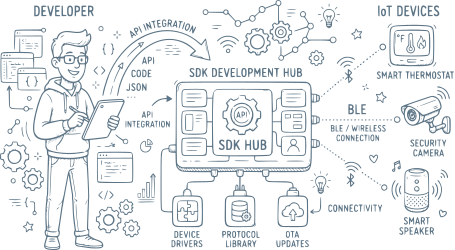
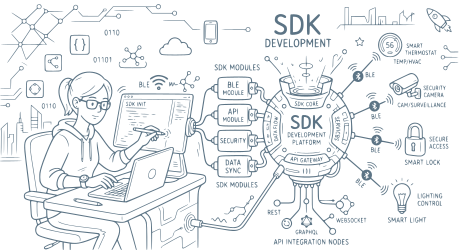
Hardware-to-software bridge SDKs for BLE, Wi-Fi, Zigbee, LoRaWAN, and NB-IoT devices. We handle device discovery, pairing, command protocols, OTA firmware updates, and real-time telemetry streaming.

Cross-Platform SDKs
Single-codebase SDKs using Flutter, React Native, or KMP that let partners integrate once and deploy across platforms. Maximum reach with minimal SDK maintenance overhead.

Cloud & API SDKs
Server-side and client-side SDKs wrapping your REST or GraphQL APIs into developer-friendly packages with built-in authentication, retry logic, rate-limit handling, and typed models.

Wearable & Health SDK Integration
SDKs for smartwatches, fitness trackers, and medical wearables. We integrate with HealthKit, Health Connect, and proprietary sensor protocols to surface biometric data cleanly inside partner apps.

Smart Device & AR/VR SDK Enablement
SDKs for smart home controllers, AR glasses, VR headsets, and embedded displays. We build the abstraction layer that lets developers control your hardware without learning your firmware.

Smart Devices & Consumer Electronics
SDK integration for smart speakers, displays, trackers, and home automation hubs

Healthcare & Wearables
Medical device SDKs, patient monitoring, HealthKit integrations, compliance-ready

Automotive & Fleet
In-vehicle SDKs, OBD-II data access, fleet telematics, connected car platforms

Smart Home & Building
Matter/Thread SDKs, HVAC control, energy management, voice assistant integration

FinTech & Payments
Payment processing SDKs, KYC modules, PCI-compliant tokenization, banking APIs

Gaming & Smart Cities
Multiplayer SDKs, in-app purchase modules, urban IoT sensor platforms, analytics

Swift
iOS-native, type-safe, protocol-oriented

Kotlin
Android-first, coroutine-powered

Flutter
Cross-platform plugin development

React Native
JS-based native module bridge

Python
Server SDKs, ML pipelines, automation

C / C++
Embedded, firmware, low-level protocols

BLE / NFC
Device pairing, data exchange, NDEF

Cloud APIs
AWS, Azure, GCP SDK wrappers

Edge Computing
On-device inference, local-first SDKs

Security
TLS, cert pinning, token management