

Hospital Staff Spend More Time on Paperwork Than Patients.

- Aug 19, 2026 |
- By Nirav Luhar - Bluepixel Team

Hospital Staff Spend More Time on Paperwork Than Patients.
How connected medical devices are closing the gap between charting and care
It's 2 a.m. on a 32-bed medical-surgical floor. A nurse pushes a vitals cart from room to room, checks blood pressure, oxygen saturation, temperature, and heart rate on each patient, then walks back to a workstation to type every number into the chart by hand. By the time the round is finished, it's almost time to start the next one. Multiply that across every nurse on every shift, in every hospital, and you get a workforce spending a startling share of its day on data entry instead of patients.
That's not an exaggeration. Depending on which study you read, nurses spend somewhere between roughly a quarter and 40 percent of a 12-hour shift on documentation. Researchers at NYU Langone Health clocked flowsheet entries at 631 to 875 per shift, close to one entry every minute. Cleveland Clinic measured about 144 minutes per 12-hour shift spent inside the EHR. The 2025 KLAS Arch Collaborative report, drawing on data from more than 80,000 acute care nurses, put it plainly: documentation requirements keep expanding, and nothing about a nurse's shift ever gets shorter to compensate.
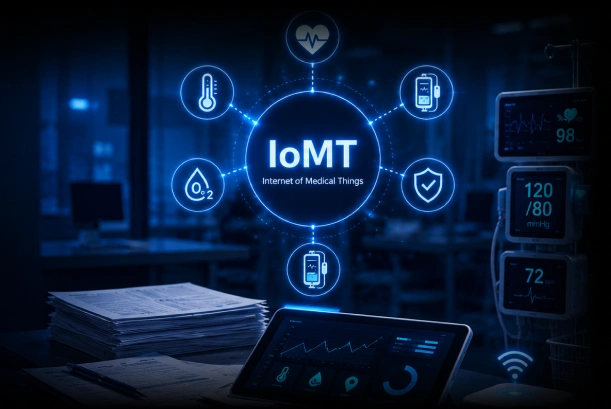
For hospital administrators already fighting to fill shifts, this isn't an abstract efficiency problem. It's a staffing problem, a safety problem, and increasingly, a budget problem. It's also exactly the pain point that IoMT (Internet of Medical Things) devices were built to solve: connected vitals monitors, wearables, and smart infusion pumps that capture data automatically instead of asking a human to write it down twice.
The Vitals Round Nobody Has Time For
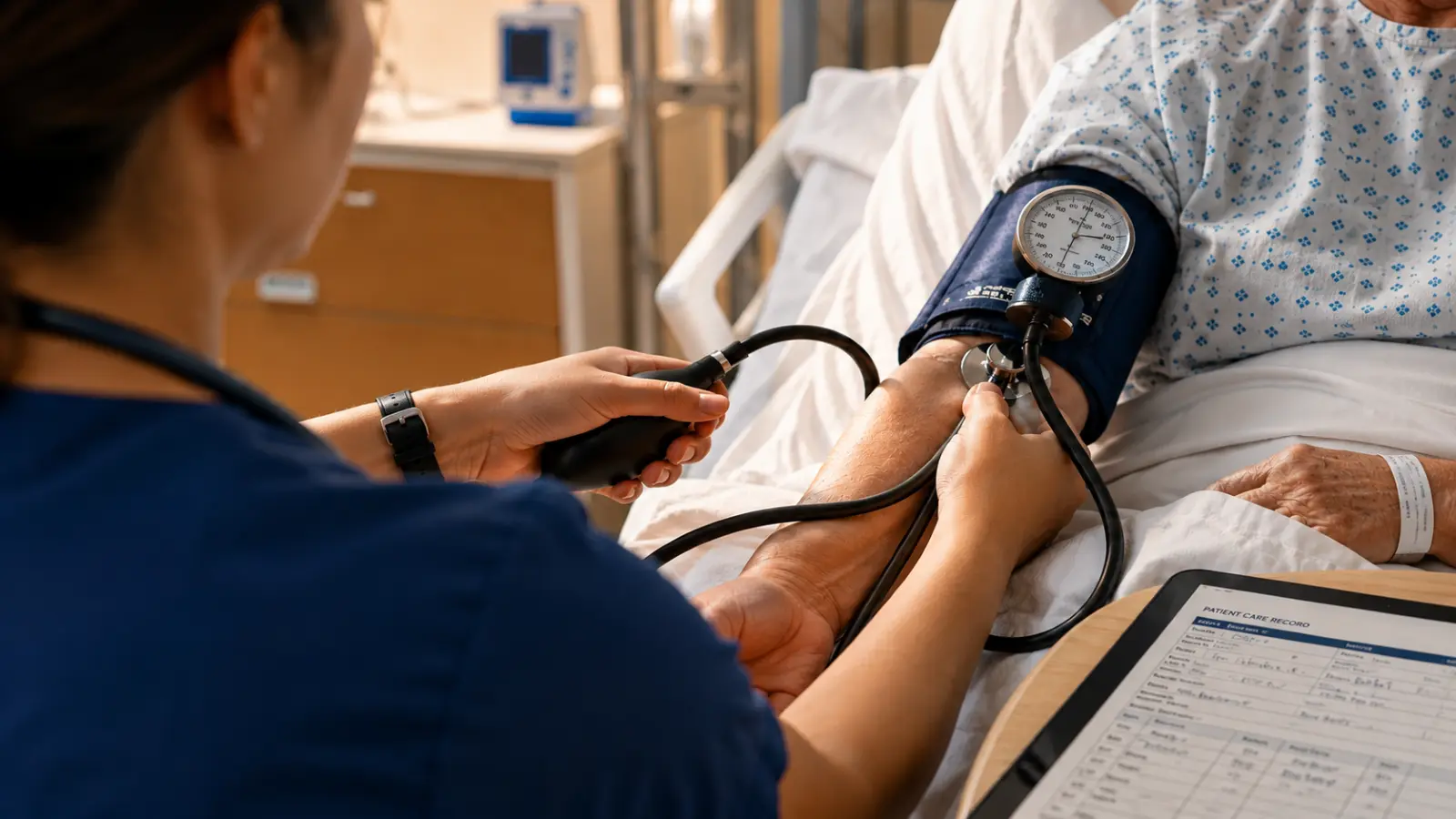
Picture a typical med-surg nurse carrying five or six patients. Every four hours, the routine repeats: wheel the cart to the bedside, take blood pressure, SpO2, temperature, and pulse, hold the numbers in your head or scribble them down, then walk back to a computer to enter them. On a busy floor that's dozens of manual readings and transcriptions per shift, done in between passing medications, managing admissions and discharges, answering call lights, and trying to actually talk to the person in the bed.
None of this is new. What's changed is the ratio. Two-thirds of hospital nurses now say staffing is insufficient, and roughly a third say they intend to leave their current job. The Health Resources and Services Administration projects a national nursing shortfall of about 8 percent in 2026, with registered nurse supply running roughly 10 percent behind demand. Fewer nurses means each one covers more patients, which means more vitals rounds, more charting, and less time for anything that isn't a task on a checklist.
Ask a bedside nurse where the shift actually goes, and manual vitals logging sits right near the top of the list, alongside medication administration. It's work that has to happen, takes real time, and doesn't require a human brain to do well. A sensor can read a number just as accurately, and it never gets pulled away mid-round to answer a call light.
Why The Paperwork Keeps Piling Up
Most hospitals are running 2026 patient volumes on infrastructure built for a different era. A lot of vitals monitoring equipment on general wards, ordinary blood pressure cuffs, pulse oximeters, and thermometers, was never designed to talk to anything. It measures a number, displays it on a small screen, and stops there. Getting that number into the patient's chart still depends on a person reading the display and typing it somewhere else.
Even where hospitals have invested in newer monitors, integration is often partial. A device might sit on a different network than the EHR, use a data format the hospital's system doesn't recognize, or simply have never been connected because IT never had the budget or the bandwidth for that specific project.
The result is what health IT teams call data silos:
- Monitors on one island
- Infusion pumps on another
- EHR on a third
- Nurse serving as the ferry between all of them
Then there's the dashboard problem. Even hospitals running several connected systems rarely have one screen where a charge nurse or physician can see every patient's current vitals at a glance. Clinical staff end up checking multiple applications, sometimes multiple logins, to piece together a picture that should exist as a single view. Legacy purchasing decisions, made monitor by monitor and department by department over a decade or more, are the quiet reason so much documentation still runs through a keyboard instead of a network.
What Manual Charting Actually Costs
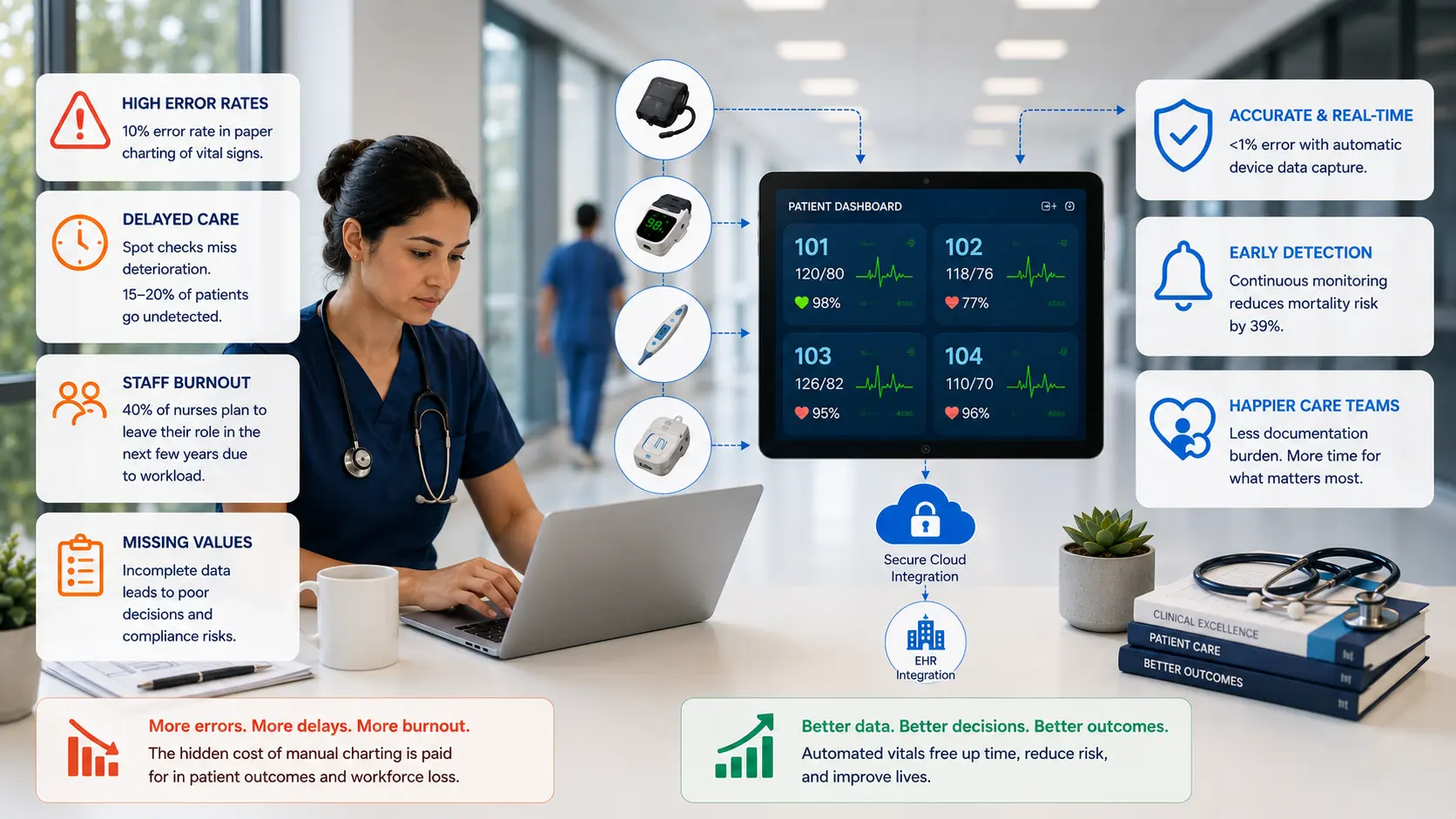
Every manual step is a chance for a small error to become a real one. A study of ICU patients found an 8.8 percent transcription error rate in laboratory results moved by hand between systems. A separate analysis of point-of-care glucose testing put the manual-entry error rate at 3.7 percent. For vital signs specifically, paper charting has been measured at around a 10 percent error rate, dropping to roughly 4.4 percent with manual EMR entry, and to under 1 percent when a device uploads the reading automatically. Multiply any of those percentages across a hospital running hundreds of vitals checks a day, and the numbers stop looking small.
Delay carries its own risk. Spot-check monitoring, the standard four-times-daily vitals round most wards still run on, has been shown to catch clinical deterioration with under 80 percent sensitivity, simply because a lot can change in the hours between checks. One meta-analysis found continuous monitoring associated with a 39 percent lower mortality risk compared with intermittent spot checks, and undetected deterioration is estimated to occur in 15 to 20 percent of hospitalized patients under standard observation protocols. That gap, between when something starts going wrong and when a nurse happens to walk back into the room, is where preventable harm lives.
There's a human cost too, and it feeds back into everything above. Burnout tied to documentation load is one of the most consistently cited reasons nurses give for leaving bedside roles, and the KLAS Arch Collaborative found that 40 percent of surveyed nurses intended to leave their current position within the next few years. Every hour spent typing vitals into a chart is an hour not spent doing the part of the job most nurses trained for in the first place.
Connected Devices, Not More Forms
IoMT
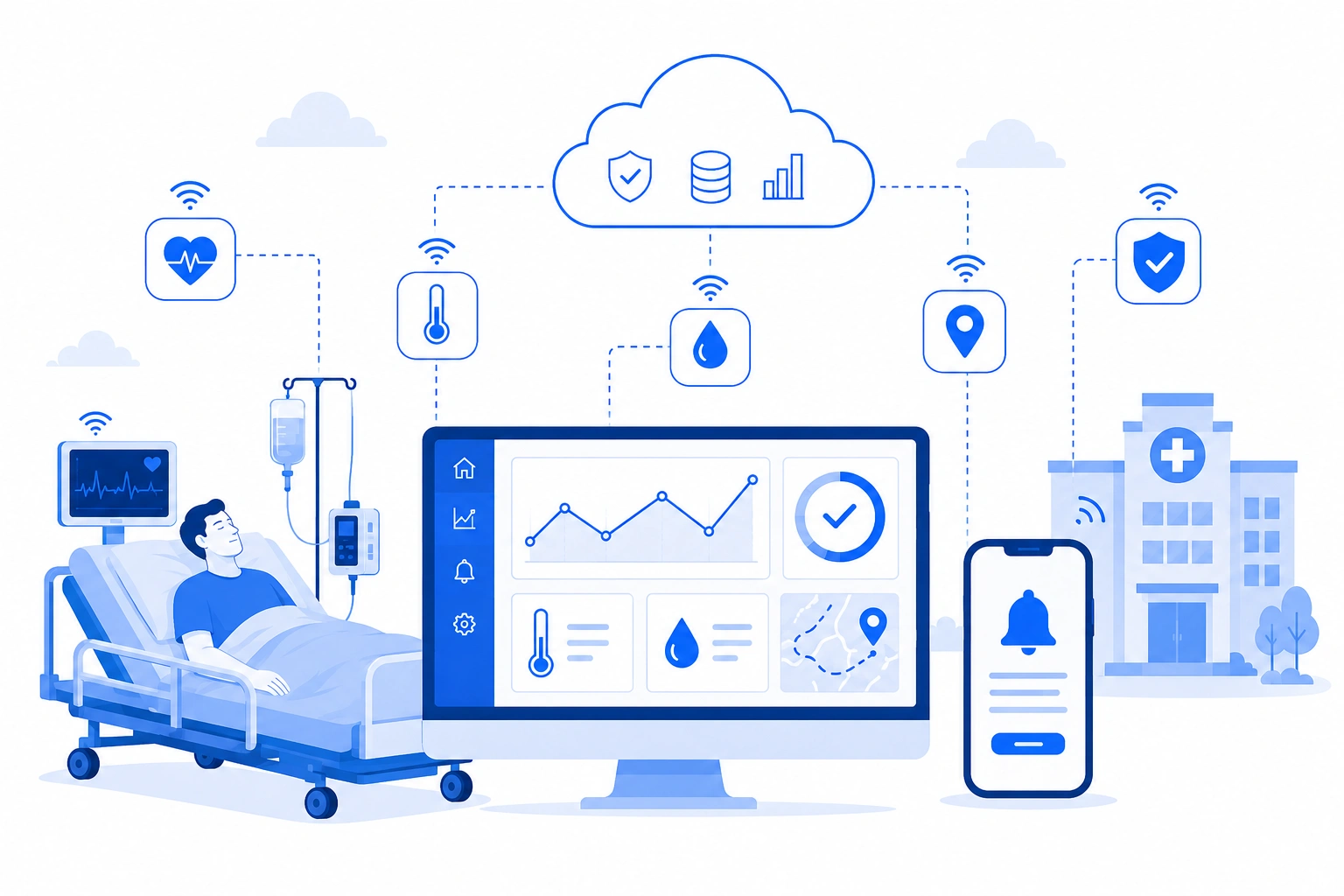
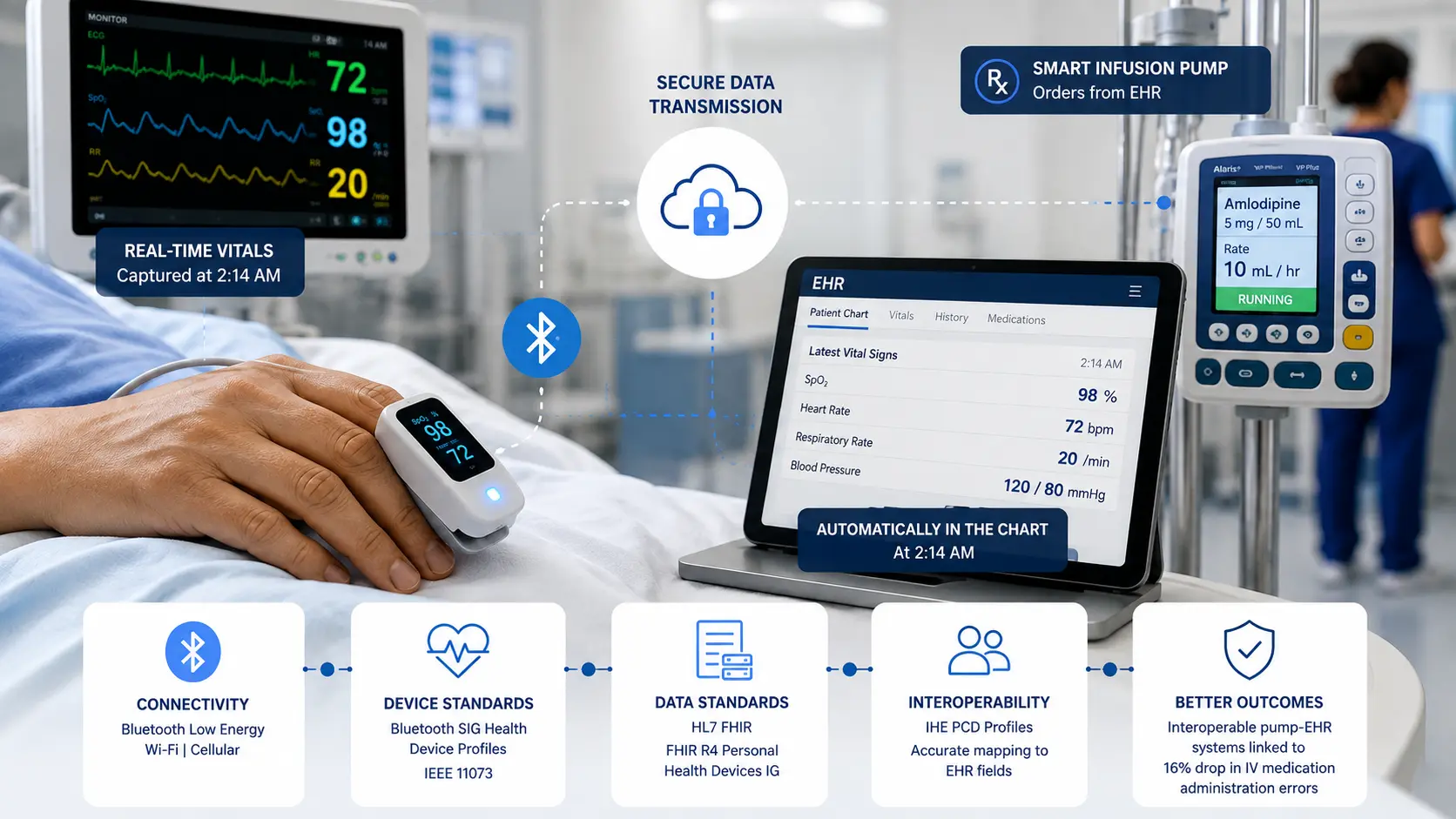
IoMT is the practical answer to a problem that more policies and more training modules haven't solved. A connected blood pressure cuff, pulse oximeter, or wearable patch measures a vital sign and sends it, over Bluetooth Low Energy, Wi-Fi, or a cellular gateway, straight into the patient's record. No cart, no clipboard, no retyping. The reading a device takes at 2:14 a.m. is the reading that lands in the chart at 2:14 a.m., not whenever a nurse gets a free minute to log it.
Underneath that simplicity is a stack of standards doing the actual work. Bluetooth SIG Health Device Profiles and IEEE 11073 define how a sensor packages and transmits a measurement. HL7 FHIR, and increasingly the FHIR R4 Personal Health Devices Implementation Guide, structures that data so it means the same thing to a monitor, a mobile app, and an EHR. IHE PCD profiles fill in the mapping rules so a heart rate reading from a bedside monitor lands in the correct field of an Epic or Cerner chart instead of getting lost in translation. None of this is exotic. Most of it has existed for years. What's changed is that connected sensors have gotten cheap enough and reliable enough for hospitals to deploy at scale instead of running a handful of pilot units on one floor.
Smart infusion pumps extend the same logic to medication delivery. When a pump communicates directly with the EHR, drug, dose, and rate come from the order itself rather than a nurse reading a label and setting dials by hand. Interoperable pump-EHR systems have been linked to a 16 percent drop in IV medication administration errors across hospitals that adopted them.
What Changes When The Data Moves Itself
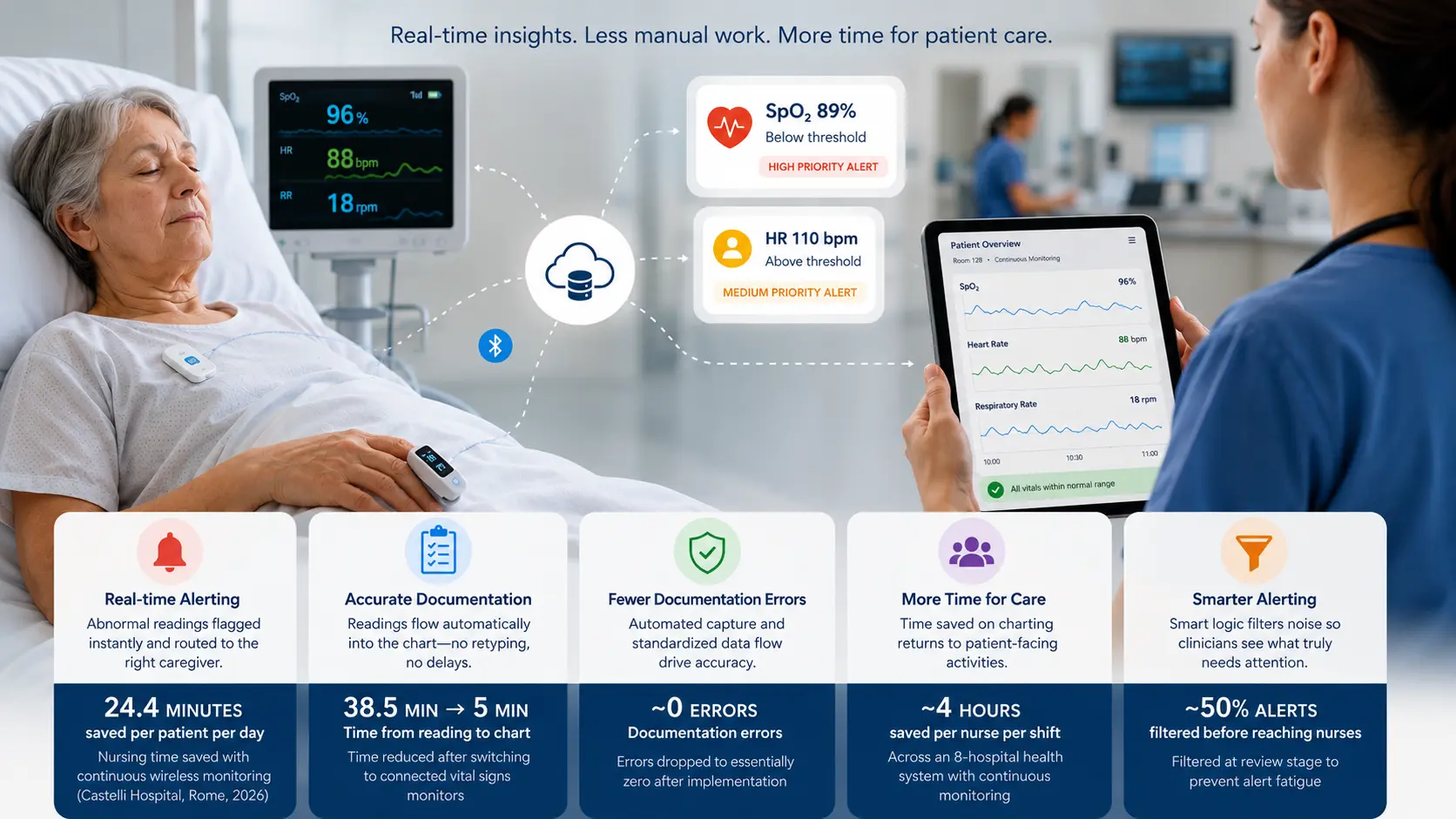
The most visible benefit is real-time alerting. Instead of waiting for the next scheduled vitals check, a connected monitor can flag an abnormal reading, a falling SpO2, a climbing heart rate, the moment it happens, and route the alert to the right nurse or rapid response team. In a 2026 pilot at Castelli Hospital in Rome, replacing intermittent bedside checks with continuous wireless monitoring didn't just improve outcomes; it cut nursing time spent on manual vitals measurement by 24.4 minutes per patient per day. On a typical 20-patient ward, that adds up to more than eight hours of nursing time freed up daily, close to an entire extra shift's worth of capacity, without hiring anyone.
Documentation accuracy improves right alongside speed. One hospital that switched from paper and manual EMR entry to connected vital signs monitors saw the average time between taking a reading and it appearing in the chart drop from 38.5 minutes to just over 5, with documentation errors falling to essentially zero. An eight-hospital health system that rolled out continuous vital sign monitoring across its wards found nurses saving roughly four hours per shift, time that went straight back into patient mobility, comfort care, and the hands-on attention that's hardest to give when you're behind on charting.
None of this works if every reading triggers a notification, which is why the systems worth deploying include smart alert logic, not just raw connectivity. That same eight-hospital rollout filtered about half of all generated alerts at a review stage before they ever reached a bedside nurse, the difference between a genuinely useful early warning system and one more source of alarm fatigue.
Where Bluepixel Technologies Fits In
Connecting a device to a hospital network sounds simple until you're the one building it. The engineering challenge sits in three places: the connectivity layer, the data pipeline, and compliance, and getting any one of them wrong turns a promising pilot into a system nobody trusts.
At the device level
We build BLE and NFC integrations that pair reliably with the sensors already sitting in a hospital's supply closet — blood pressure cuffs, pulse oximeters, glucometers, infusion pumps rather than forcing a rip-and-replace of equipment that still works fine.
On the data side
we design cloud pipelines that move vitals from device to EHR in near real time, structured around HL7 FHIR so the data a monitor produces is immediately usable by clinical systems instead of sitting in a proprietary format that needs a separate translation layer.
Compliance
Compliance isn't an afterthought bolted on at the end; it shapes the architecture from day one. Encryption in transit and at rest, access controls scoped to what each role actually needs to see, and audit trails that hold up under a HIPAA review get built into the pipeline itself, not patched in right before a security audit. That's the difference between an IoMT deployment that survives contact with a hospital's IT and compliance teams, and one that stalls in procurement.
We've spent years building this kind of infrastructure device connectivity, secure data movement, and healthcare-grade compliance for clients moving from disconnected equipment to systems that actually talk to each other. If your hospital or clinic is evaluating IoMT solutions and trying to figure out where to start, that's a conversation worth having early, before the RFP goes out.
The Bottom Line
The math is straightforward. Every minute a nurse spends transcribing a blood pressure reading is a minute not spent noticing that a patient's color has changed, or answering a question a family member is too anxious to ask twice. Connected devices don't replace clinical judgment. They give it more room to work by taking the repetitive, error-prone parts of monitoring off a human's plate and putting them where they belong: inside a system built to move data quickly and correctly, every time.
Hospitals that make this shift aren't chasing a trend. They're addressing the same staffing and burnout pressures every administrator already sees on a scheduling spreadsheet, just from the equipment side instead of the hiring side. The devices exist, the standards exist, and the cost of deploying them keeps falling. The question left for most hospitals isn't whether to connect their monitoring equipment. It's who's going to build that connection properly.
Share Article
Linkedin
Facebook
Copy link
Recent Blogs

August 5, 2026

July 29, 2026
Share Article
Linkedin
Facebook
Copy link