

How Sensors and AI Are Helping Factories Fix Machines Before They Break

- Aug 13, 2026 |
- By Gaurav Harkhani - Bluepixel Team

How Sensors and AI Are Helping Factories Fix Machines Before They Break
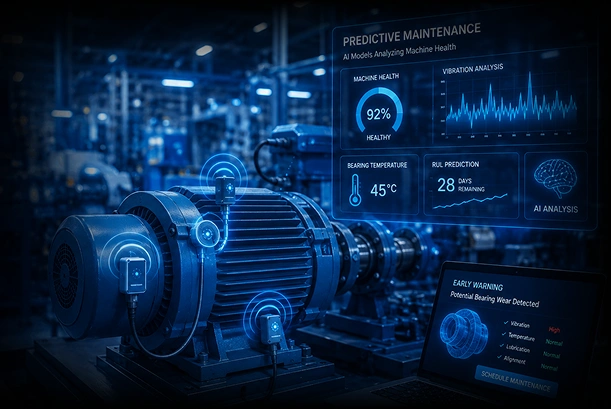
A motor inside of the factory is about to break down. And it starts to vibrate subtly - not enough for a passing worker to notice. “Just a little something that’s “off” … so why should it just wait until Thursday morning when we realize that the assembly line has stalled. Why shouldn’t it be alert to this very small tremor that starts on Tuesday afternoon before any breakdown occurs?
That concept is predictive maintenance, one of the more tangible applications where IoT and AI are already being paired together on factory floors today.
The Problem: Machines Break at the Worst Times
Most factories deal with equipment breakdowns in one of two ways:
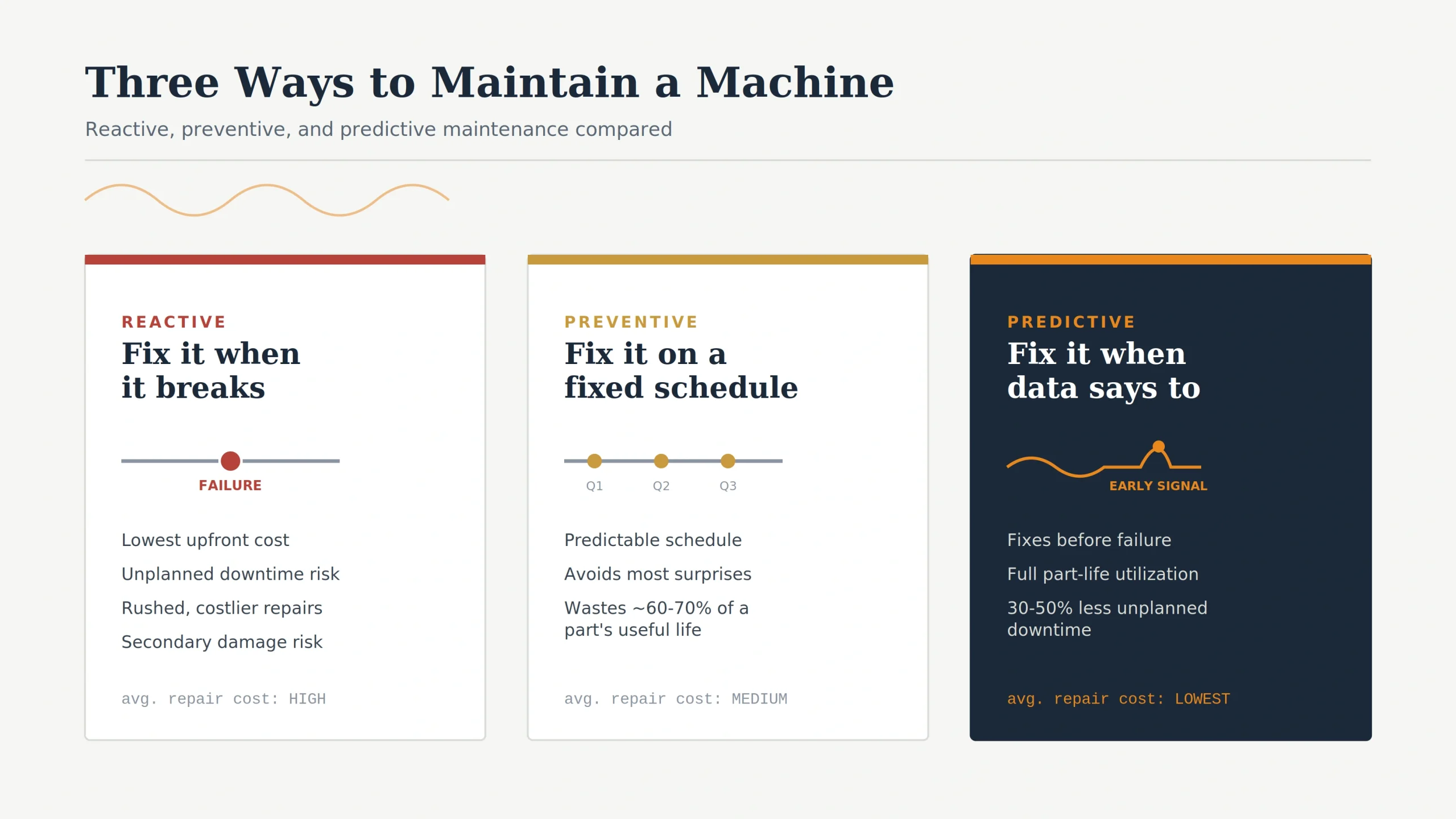
1. Reactive maintenance
Fix it when it breaks. Simple, but risky - a breakdown can shut down a whole production line for hours, and repairs done in a rush cost more.
2. Preventive maintenance
Replace parts on a fixed schedule regardless of actual condition, like changing your car's oil every 3 months no matter how much you've driven. This avoids surprises, but on average it also means discarding 60-70% of a component's remaining useful life.
Predictive maintenance replaces the calendar with condition data: continuously monitor how a machine is actually performing, and only intervene when the data shows real degradation.
Step One: Building the Sensing Layer
Sensors attach directly to rotating equipment - motors, pumps, compressors, gearboxes - since these fail in fairly predictable, measurable ways. Three signals matter most:
Vibration
Vibration, measured with a triaxial accelerometer. This is the earliest and richest signal: bearing wear, imbalance, and misalignment each produce a distinct vibration signature well before the failure becomes audible or visible. Because bearing fault frequencies typically fall in the 1-10 kHz range, the sensor's sampling rate needs to be at least 20 kHz to capture them cleanly (per the Nyquist criterion) - a meaningfully higher spec than a typical environmental IoT sensor.
Temperature
Temperature, as a slower-moving confirmation signal - useful, but it tends to show up later in a failure sequence than vibration does.
Motor current signature analysis (MCSA)
Motor current signature analysis (MCSA), where accessible - a struggling motor draws current differently than a healthy one, giving a second independent signal without adding a sensor to the machine itself.
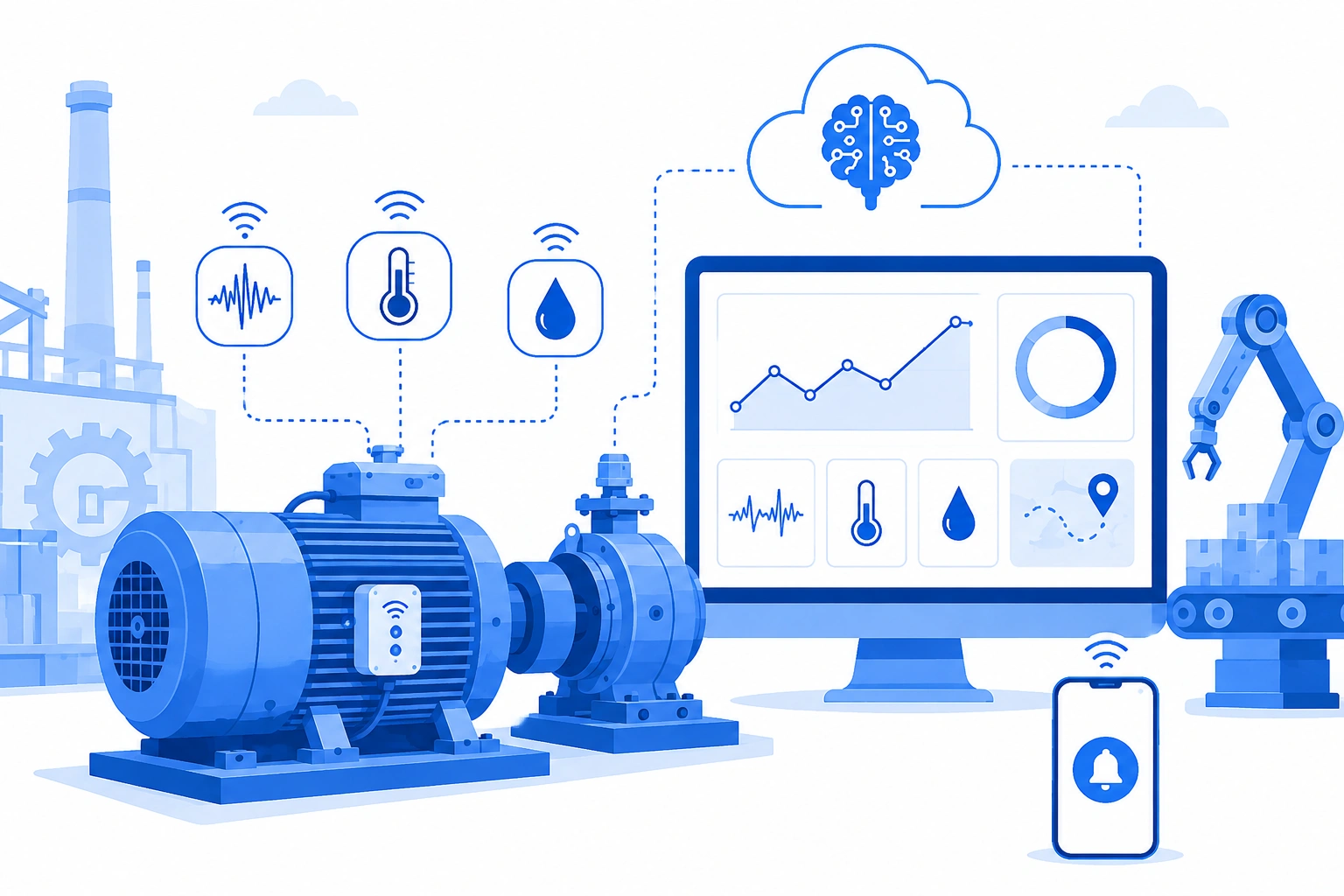
Get data from the machine, without fail This typically works the same way: the sensors pass wireless data to a local gateway which then uploads it to the cloud, again, often using MQTT. Which of those last two types of radio technology you use is going to largely be dictated by plant layout:
- BLE for when equipment is tightly grouped (e.g., an assembly of pumps skids all sitting close together);
- LoRaWAN if you need to reach assets deployed over a large yard or wide plant;
- NB-IoT if an asset isn’t near any gateway but does have cell signal.
Power budget drives the design. Streaming raw high-rate vibration data would drain a coin-cell battery in days. The practical pattern is edge-triggered sampling: wake up for 1-2 seconds every few minutes, compute a set of summary statistics locally, and transmit only that compact feature vector rather than the raw waveform - the sensor equivalent of a fitness tracker checking your heart rate periodically instead of streaming every heartbeat.
A basic AWS-based ingestion path looks like:
Sensor → Gateway → MQTT (AWS IoT Core) → Kinesis Data Streams
→ Lambda (validation/enrichment) → Timestream (time-series storage)
→ Model inference → Alerting
Two easy-to-underestimate details: gateway clocks need NTP sync so vibration timestamps stay accurate across nodes, and the ingestion schema should be versioned from day one, since the feature set will evolve as the model matures.
Step Two: Turning Signal Into Prediction
Raw vibration waveforms aren't fed straight into a model. They're converted first into a smaller set of engineered features per sampling window:
- Time-domain features - RMS, peak amplitude, crest factor, and kurtosis (kurtosis in particular is a strong early indicator of bearing spalling, since it captures the sharp, impulsive spikes an early-stage defect produces).
- Frequency-domain features - an FFT of the vibration signal, checked against known fault frequencies calculated from the bearing's geometry (ball pass frequency outer/inner race, ball spin frequency).
- Envelope analysis - a technique that demodulates high-frequency resonance to surface very early-stage bearing defects that don't yet show up clearly in a raw FFT.
The vast majority of real deployments turn out to be hybrid - a lightweight anomaly detector right on the edge so you'll still get an alert if connectivity goes down, along with sending the full stream of features up to the cloud to train a more comprehensive model.
| Parameter | At the edge | In the cloud |
|---|---|---|
| Speed | Immediate, works without connectivity | Depends on network availability |
| Model complexity | Limited - small, quantized models | No real limit |
| Updating the model | Requires pushing new firmware to the device | Redeploy instantly |
| Best suited for | Safety-critical alerts, low-bandwidth links (LoRaWAN) | Fleet-wide analysis, more complex models |
Which model when?
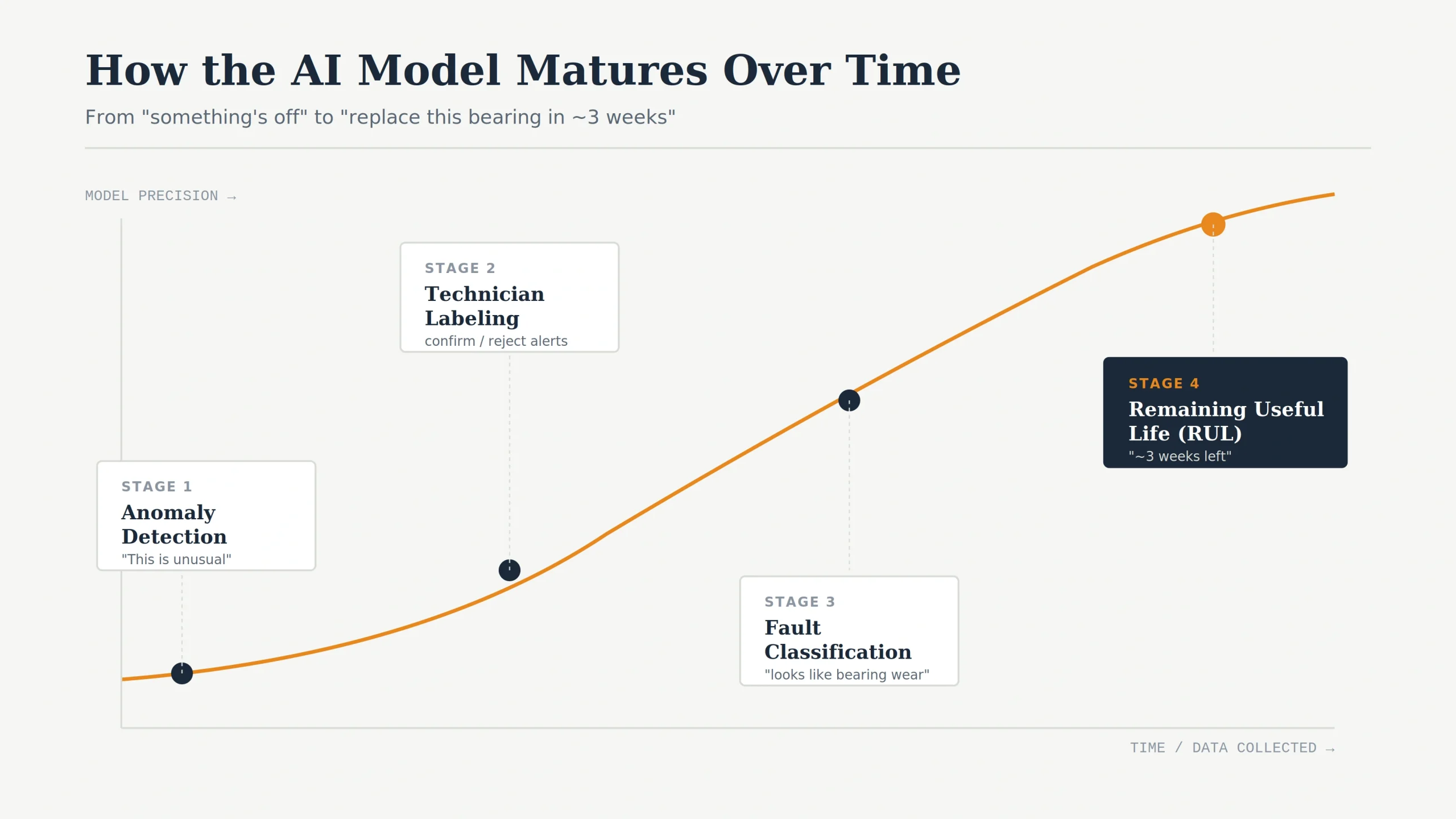
1. At the beginning, most plants have little-to-no labeled fault data (think 3 years of sensor history but only 2 recorded bearing failures).
2. So a model roadmap usually looks like so, Unsupervised Anomaly detection upfront
3. Using isolation forests or autoencoders that learn what is 'normal' and flag high reconstruction errors. The only real input needed here is the data from a working system, the thing every plant already has. Human in the loop labelling: A technician confirms or dismisses each generated alert, building a labelled data set over time. Supervised classification once enough data labels become available: usually a boost-based model on some carefully crafted features, often a gradient boosting method like XGBoost - can identify the specific fault rather than just 'something is not right' and tends to be easier to explain than deep learning models.
4. Remaining useful life estimates on top: once a lot of 'run-to-failure' history has been acquired, usually with methods from survival modelling like Weibull.
Skipping straight to a supervised classifier before real labels exist is one of the more common mistakes - it just trains the model on noisy maintenance-log guesses instead of real outcomes.
Closing the loop. When the model is confident enough, it should automatically open a work order in whatever maintenance system the plant already uses (most commonly a CMMS), including the asset ID, the likely fault type, a confidence score, and the underlying trend - so the technician has a starting point instead of a black-box alarm. That confirmation/rejection feedback from the technician is what feeds step 2 above and keeps the model improving.
What This Actually Delivers
Deployments of this kind typically produce:
- 30-50% fewer unplanned shutdowns on monitored assets
- 10-20% lower maintenance labor cost, from cutting unnecessary scheduled teardowns
- Longer equipment life, since imbalance and misalignment get caught early, before they damage coupled components
Where It Gets Hard in Practice
Retrofit constraints
Older equipment wasn't designed with sensor mounting in mind. Magnetic or adhesive mounts are faster to install than permanent studs, but introduce more measurement noise - a real tradeoff, not a minor detail.
RF environment
Dense metal machinery is a difficult environment for both BLE and LoRaWAN signal propagation; a site survey before placing gateways isn't optional.
Label scarcity
As noted above, most plants start with very few confirmed failures. Plan the model roadmap around that reality rather than assuming clean labeled data will be there from day one.
Organizational adoption
An accurate model still fails as a program if the alerts don't integrate cleanly into the CMMS workflow the maintenance team already uses, or if false positives erode trust early on.
The Bottom Line
Predictive maintenance isn't an AI or IoT problem exclusively - these things are inextricably bound together. The sensor network has to exist to serve what the model actually needs (proper sampling rate, required features, power-aware transmission), and the model has to exist to leverage what the sensor network can actually provide (limited label availability, flaky comms, edge constraints). That working relationship gets hammered home right, and the ROI comes naturally.
Bluepixel Technologies builds these systems end-to-end - wireless sensor design and firmware, cloud data pipelines, and the ML models behind them. If you're evaluating a predictive maintenance program.
Share Article
Linkedin
Facebook
Copy link
Recent Blogs




Share Article
Linkedin
Facebook
Copy link