

Connected Devices Aren’t the Challenge Anymore. Connected Decisions Are.


- Aug 26, 2026 |
- By Kirti Sharma - Bluepixel Team

Connected Devices Aren't the Challenge Anymore. Connected Decisions Are.
IoT adoption has crossed a maturity threshold. For many IoT deployments, getting devices connected is no longer the hardest part. Mature connectivity technologies, cloud platforms, and lower-cost hardware have made device onboarding more accessible. The harder challenge increasingly begins after the data starts flowing: deciding what matters, what requires action, and how quickly the system should respond.
This shift moves the center of gravity in IoT strategy from infrastructure to intelligence, from connectivity to measurable business outcomes, powered by AI, analytics, automation, and integrated workflows.
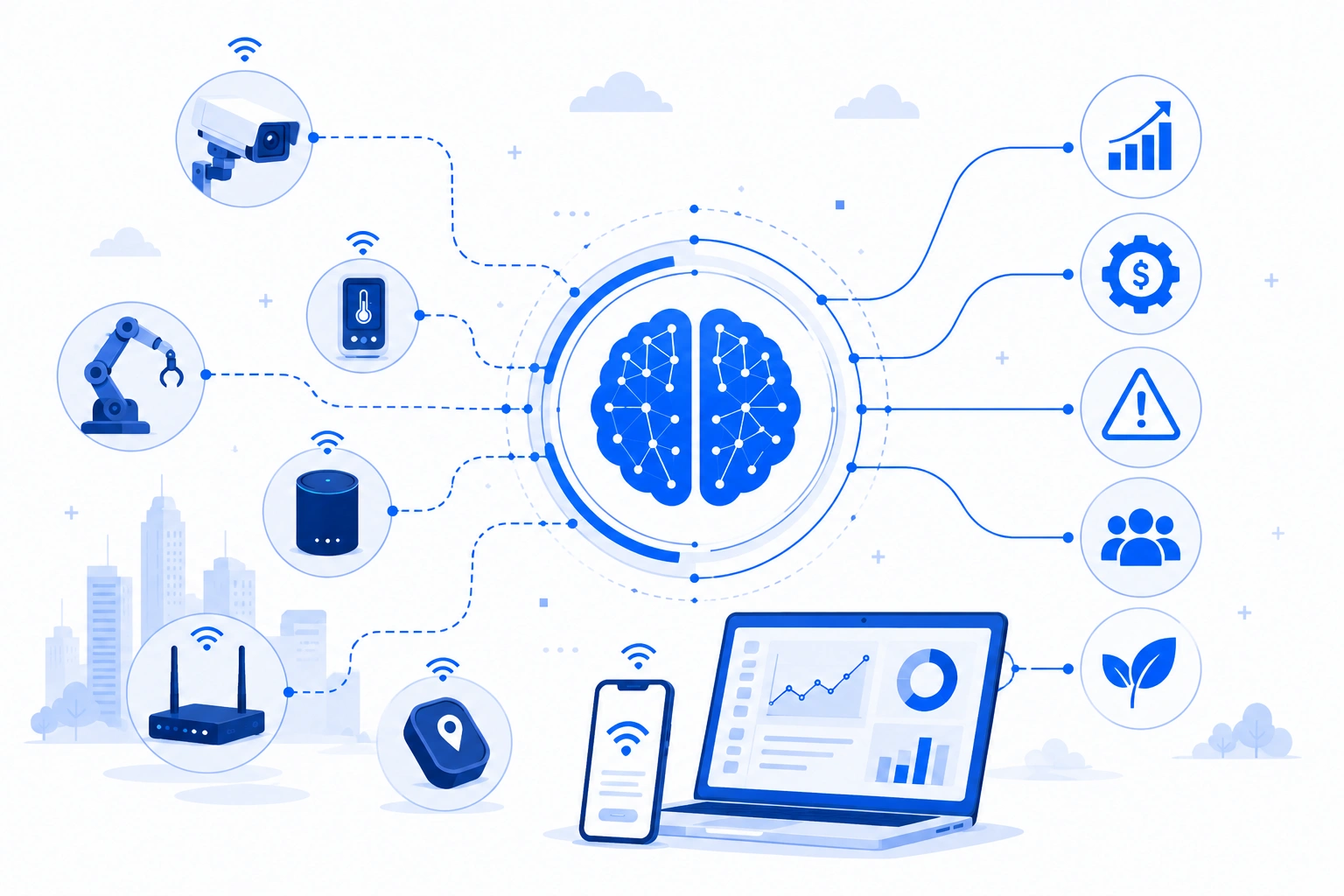
1. The evolution of IoT can be understood as a progression through four stages
The first wave of IoT was about proving connectivity was possible: getting a sensor on a machine, a wearable on a patient, or a beacon on a shelf, and streaming that signal somewhere useful. The second wave was about scale, connecting thousands of devices across a fleet, a hospital network, or a store chain.
Today's wave is different. Many mature IoT deployments already have the data pipelines in place, the differentiator now is what happens after the data arrives. Leading organizations are building a layer of intelligence on top of their IoT infrastructure that senses, reasons, and acts, closing the loop between what a device reports and what the business does next.
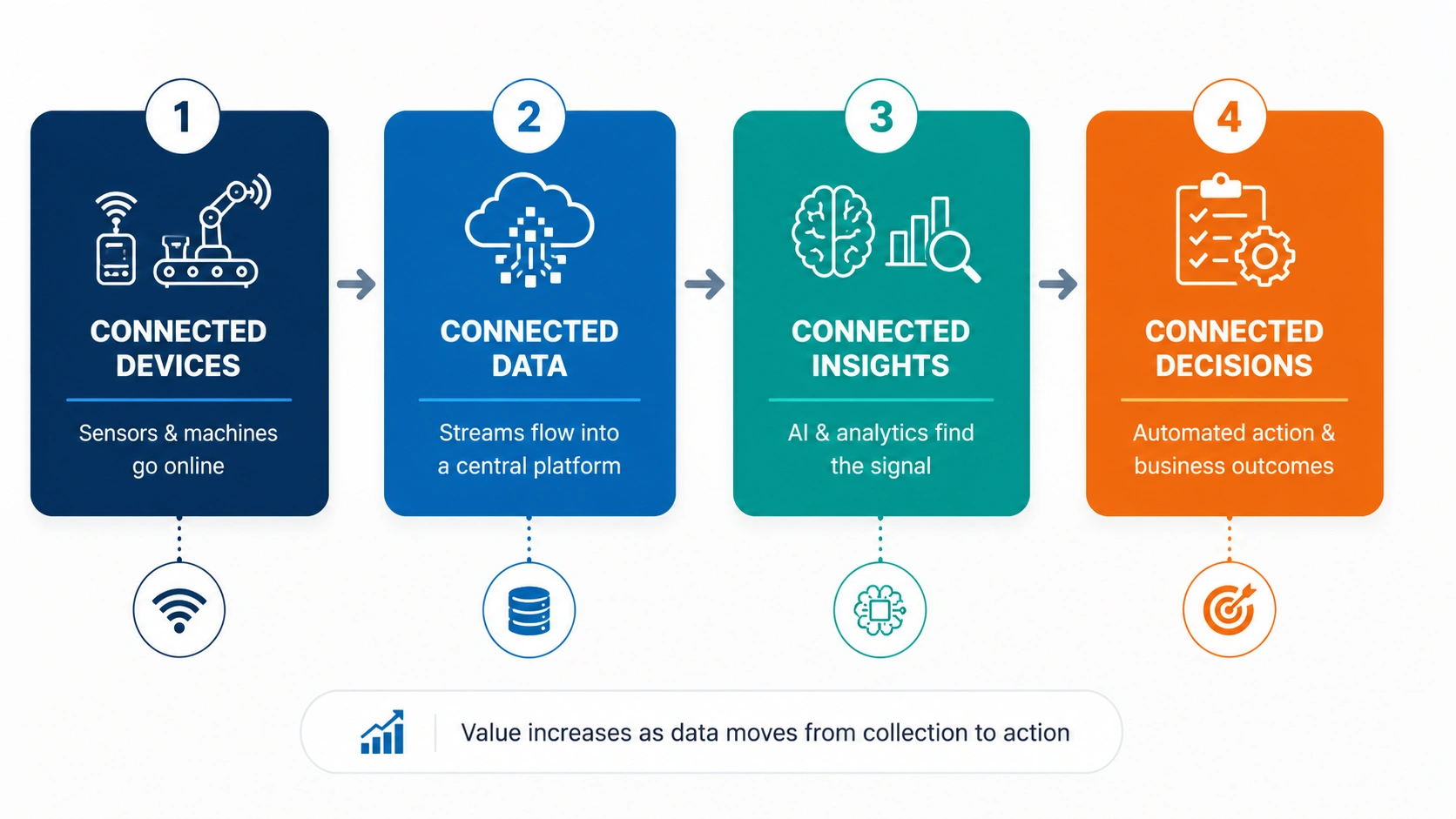
Stage 1 – Connectivity
Devices establish presence; machines, assets, and people become visible in real time.
Stage 2 – Connected Data
Data pipelines aggregate readings into a central platform, but remain largely descriptive.
Stage 3 – Connected Intelligence
AI and analytics convert raw signals into patterns, predictions, and prioritized insight.
Stage 4 – Decisions
Automated workflows and human decision-makers act on that insight in near real time.
2. Why Collecting Data Alone Is No Longer Enough
Dashboards full of live metrics can create an illusion of control. But a dashboard that nobody acts on is just a more expensive way of ignoring a problem. Data on its own doesn't reduce downtime, doesn't shorten patient wait times, and doesn't prevent stockouts. Decisions and actions do.
Three gaps typically separate “data-rich” organizations from “decision-ready” ones:
Context gap
Teams can see that a metric moved, but not why, or what to do about it.
Timing gap
Insight arrives after the moment it could have changed an outcome has already passed.
Ownership gap
Insight sits in one tool while the workflow that could act on it lives in another.
Action Gap
The system identifies what should happen next, but execution still depends on a manual process.
Closing these gaps is what turns an IoT deployment from a monitoring project into a genuine driver of operational performance and ROI.
3. Common Challenges: Data Overload, Alert Fatigue, and Disconnected Systems
As device counts and data volumes grow, three recurring failure patterns appear across connected operations in many industries:
| Challenge | What It Looks Like | Why It Sticks |
|---|---|---|
| Data Overload | High-volume telemetry is collected without sufficient filtering, aggregation, or prioritization, making important events difficult to distinguish from routine signals. | It's easier to keep ingesting everything than to make the harder call about what to filter out. |
| Alert Fatigue | Poorly tuned or context-free thresholds generate excessive alerts, causing operators to gradually ignore notifications—including the ones that matter. | Thresholds were set once, early, and nobody owns the job of continuously tuning them. |
| Disconnected Systems | The IoT platform can detect an anomaly, but the ERP, CRM, or EHR that would act on it is a separate system with no shared trigger. | Each system was procured and built by a different team, at a different time, for a different purpose. |
The organizations that manage this well don't try to eliminate alerts entirely, they redesign the funnel so that only high-confidence, high-priority signals reach a human or trigger an automated response.
4. How AI, Analytics, and Automation Transform IoT Data Into Actionable Insights
Turning connected data into connected decisions requires stitching together four capabilities. None of them is sufficient alone, the value comes from the combination.
Real-Time Analytics
Streaming analytics evaluates events continuously as data arrives, while edge processing can handle latency-sensitive filtering or decisions closer to the device.
Predictive & Prescriptive AI
Machine learning models forecast failures, demand shifts, or risk events before they occur and increasingly recommend the next best action.
Intelligent Automation
Automation should operate within defined business rules, confidence thresholds, permissions, and human-approval requirements appropriate to the risk of the decision.
Integrated Workflows
IoT platforms can integrate with ERP, CRM, MES, EHR and other operational systems through APIs, event-driven integrations, middleware, or industry-specific interfaces.
Together, these capabilities form a decision layer between raw telemetry and operational workflows. The connective tissue that turns device signals into measurable business outcomes such as reduced downtime, faster response times, optimized inventory, and more reliable deliveries.
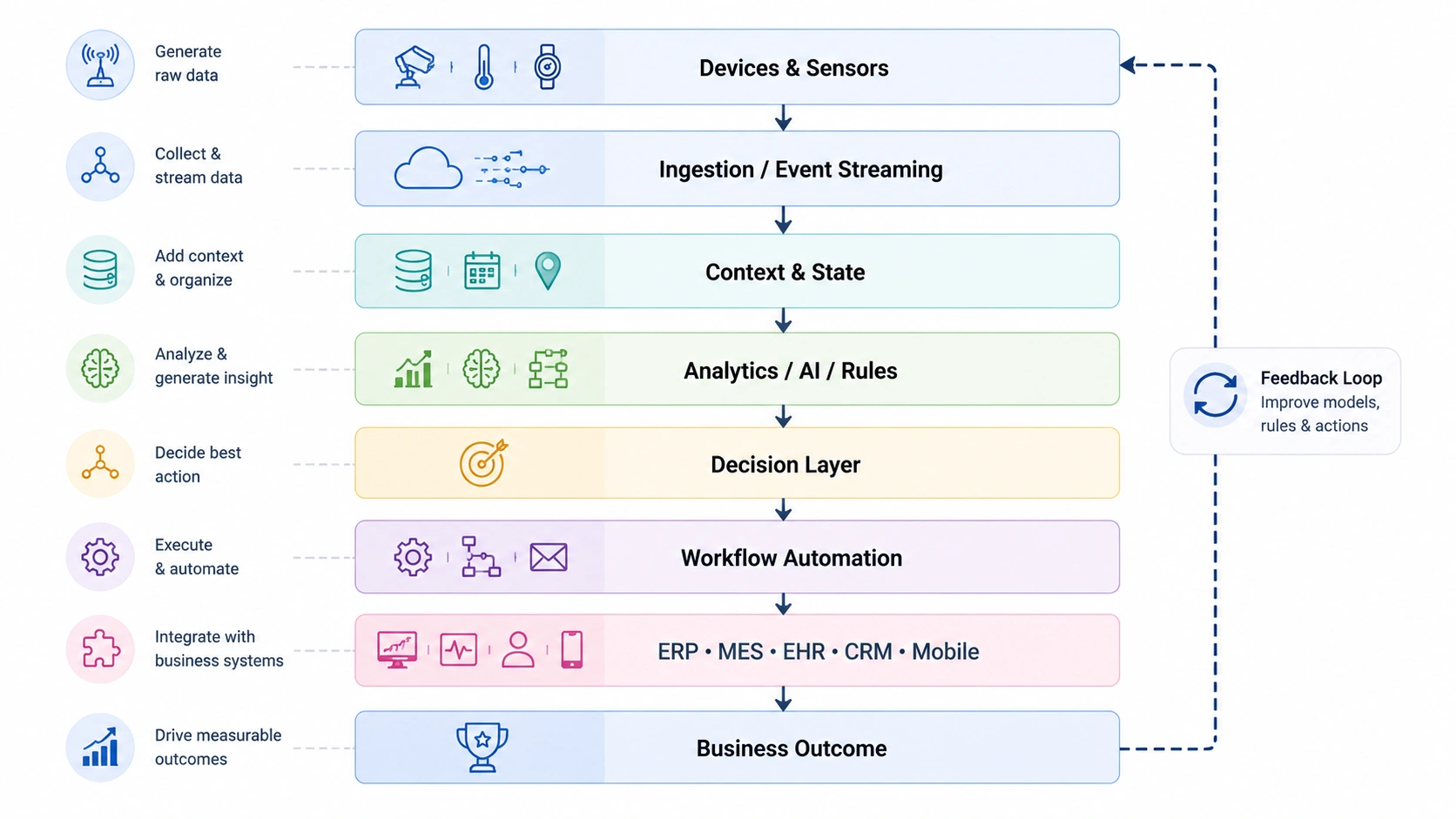
5. What This Looks Like Across Industries
The specifics differ, but the underlying move is identical everywhere: replace a human manually bridging two systems with a model and a workflow that bridge them automatically.
MANUFACTURING
Vibration and thermal sensors have been common on production lines for years, the shift is what happens after a reading looks abnormal. Instead of an engineer reviewing a weekly report, a predictive model can identify a bearing exhibiting a known failure pattern, estimate increasing failure risk, and when confidence and business rules permit, trigger a maintenance workflow before an emergency stoppage occurs.
HEALTHCARE
Remote monitors already stream vitals continuously; the bottleneck has always been clinician attention, which is finite and already stretched thin. Early-warning models can combine multiple vital-sign trends to help prioritize patients for clinician review, reducing noise while keeping clinical judgment with qualified healthcare professionals.
RETAIL
IoT shelf-availability data, POS transactions, and inventory signals can be combined with contextual data such as promotions, seasonality, and weather to create a more accurate picture of demand. Instead of waiting for a shelf to empty before reacting, retailers can identify potential stockouts earlier and trigger replenishment recommendations or workflows based on current inventory levels and predicted demand.
LOGISTICS
Telematics have made fleets visible for years; the next step is using that real-time data to continuously improve operational decisions. Vehicle location, traffic conditions, weather, delivery priorities, and vehicle-health signals can be evaluated together to dynamically recommend or execute route changes according to predefined operational rules. Updated ETAs can then flow automatically to dispatch systems and customer notifications, reducing manual intervention while allowing human oversight where exceptions or higher-risk decisions require it.
6. How Mature Is Your Decision-Making?
Rather than asking “do we use AI?” which is easy to answer yes to without making any changes, it's better to ask which of the four operating modes best fits how your organization reacts to signals from the field. The questions in the next section will go back to these levels.
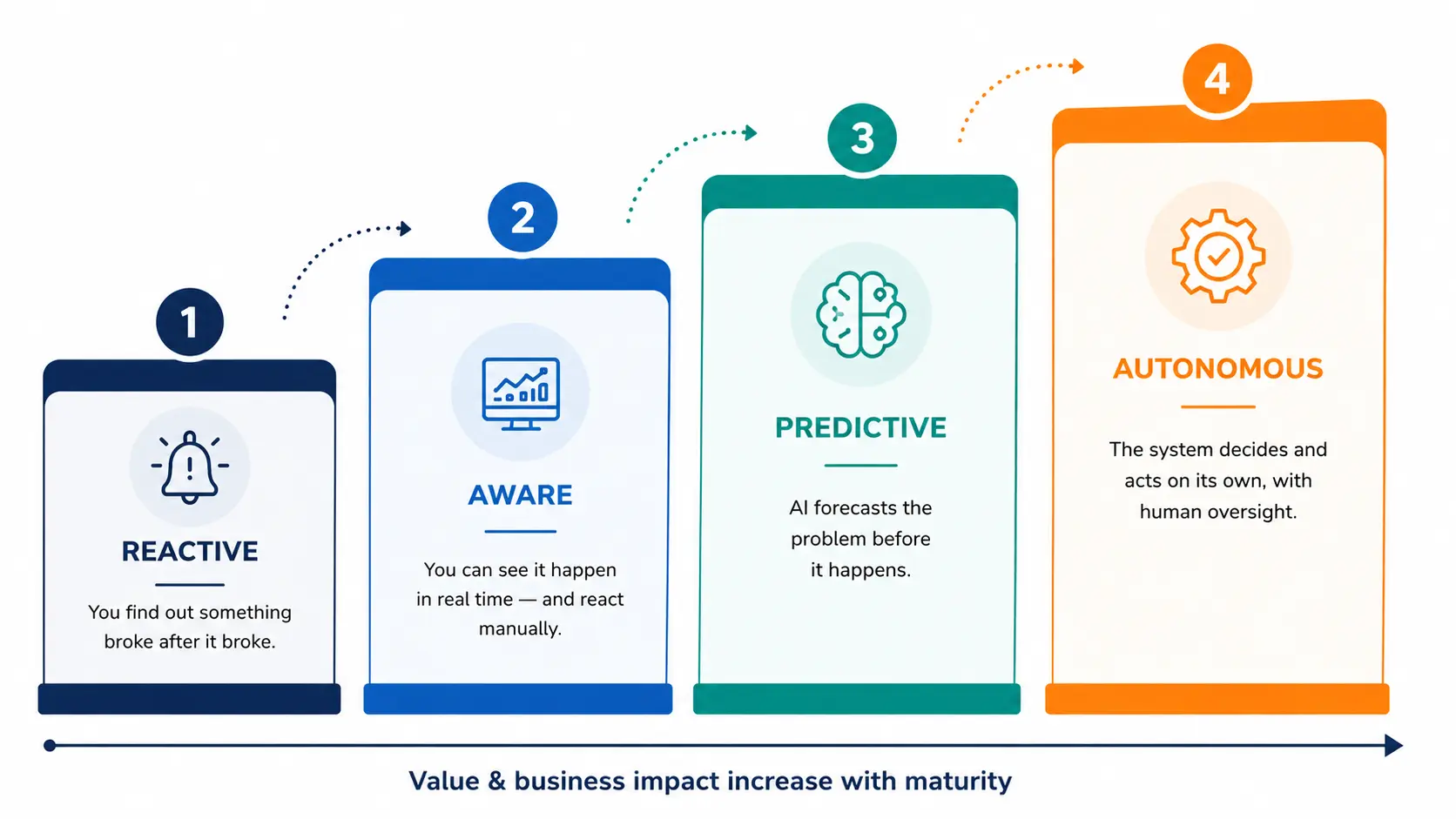
Level 1
Reactive
A pump fails, and only then does anyone learn it was overheating for a week. This is where legacy operations still live, IoT investment notwithstanding.
Level 2
Aware
Dashboards show the overheating in real time, but someone still has to notice it, judge its severity, and manually start a response. This is a common plateau for IoT programs after initial monitoring capabilities are deployed.
Level 3
Predictive
A model recognizes the failure signature days in advance and tells the right person before it becomes urgent. This is where AI can begin creating measurable operational value by enabling teams to intervene before failures or disruptions occur.
Level 4
Autonomous
The system doesn't wait for a person. It opens the work order, reroutes the load, or reorders the part on its own, within guardrails a human has approved in advance.
7. Five Questions Worth Asking Before Your Next IoT Investment
Before adding more sensors, more dashboards, or more AI features, it's worth pressure-testing the current setup with a few honest questions.
If not, you’re building on Level 1 or 2 no matter how sophisticated the analytics layer looks.
If a person has to manually move information between two systems, that handoff may be one of your bottlenecks, even if the underlying data quality is good.
If the answer is “when someone complains,” alert fatigue is already costing you attention on the alerts that matter.
Matching autonomy to the actual cost of a slow or wrong decision, not maximizing automation everywhere is what makes the investment defensible.
Technical metrics such as connectivity rate, latency, and model performance still matter, but they should ultimately connect to business outcomes such as uptime, cost, service quality, safety, or customer satisfaction.
Ready to Move From Connected Devices to Connected Decisions?
Looking to build an intelligent IoT platform that goes beyond device connectivity? Bluepixel Technologies develops custom IoT, AI, cloud, mobile, analytics, and enterprise software solutions that help businesses turn connected data into actionable insights and automated decisions.
Share Article
Linkedin
Facebook
Copy link
Recent Blogs
August 19, 2026

August 5, 2026

July 29, 2026
Share Article
Linkedin
Facebook
Copy link