There's a moment almost everyone has experienced in the last couple of years.
You type something into ChatGPT maybe a question about your taxes, or a half-baked idea for a story and what comes back is so coherent, so on point, that you lean back in your chair and think: okay, but how is it actually doing that?
It doesn't feel like a search engine. It doesn't feel like autocomplete. It feels, unsettlingly, like something is thinking on the other side of the screen.
Here's the truth: it is thinking just not the way you think it's thinking.
The Word "Intelligence" Is Doing a Lot of Heavy Lifting
Let's get one thing out of the way early. When we say AI is "intelligent," we're using the word pretty loosely.
A calculator is not intelligent. It just follows rules. A chess engine isn't intelligent either it's exceptionally fast at evaluating millions of possible moves using rules humans programmed in. For decades, AI was basically this: smarter rule-following.
What changed what makes modern AI feel different is that we stopped writing the rules ourselves. Instead, we gave machines enormous amounts of data and let them figure out the rules on their own.
That shift sounds small. It isn't.
Architecture
What a Neural Network Actually Is
The core engine behind almost every AI system you interact with today ChatGPT, image generators, voice assistants, spam filters is something called a neural network.
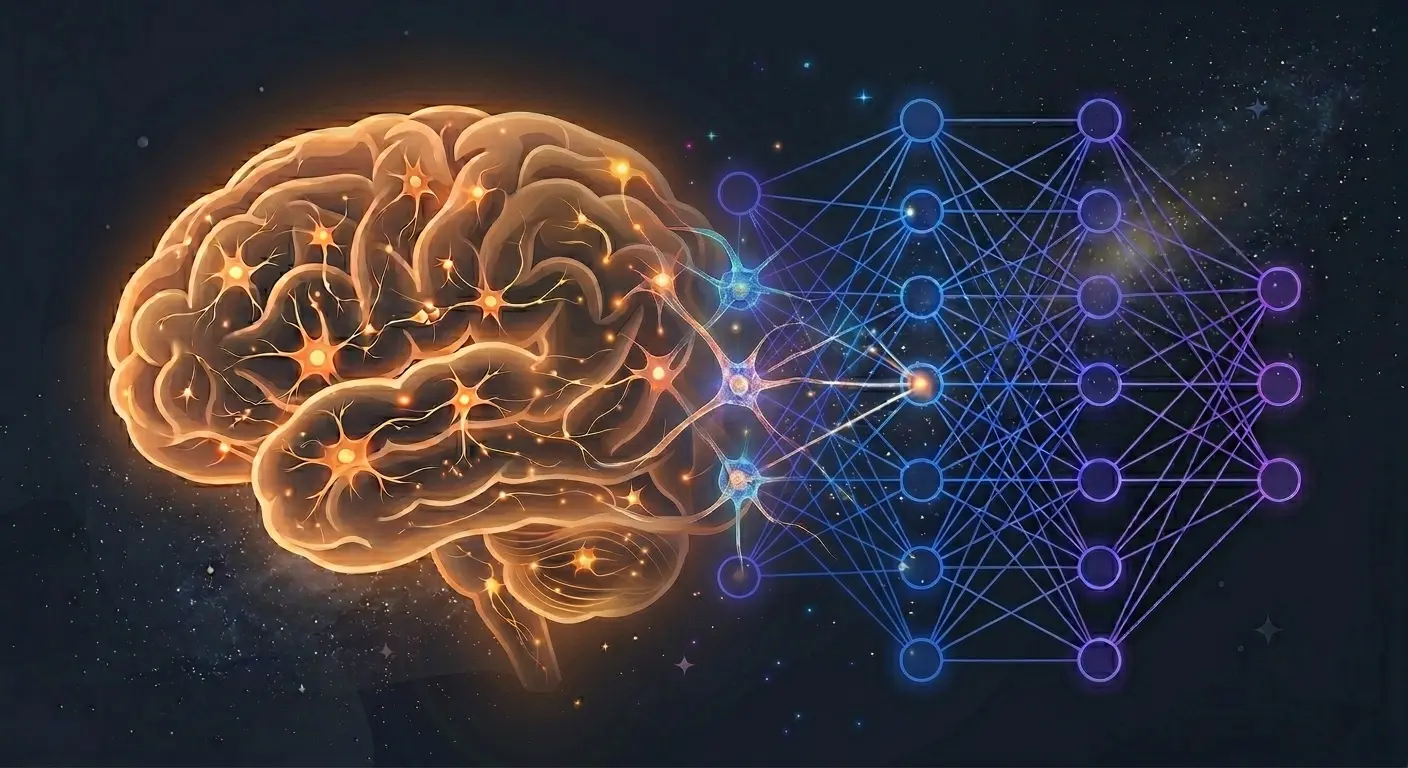
The name is borrowed from biology. Your brain has about 86 billion neurons, each connected to thousands of others. When you learn something say, that fire is hot the connections between certain neurons get stronger. Do it enough times and those connections become automatic. That's memory. That's learning.
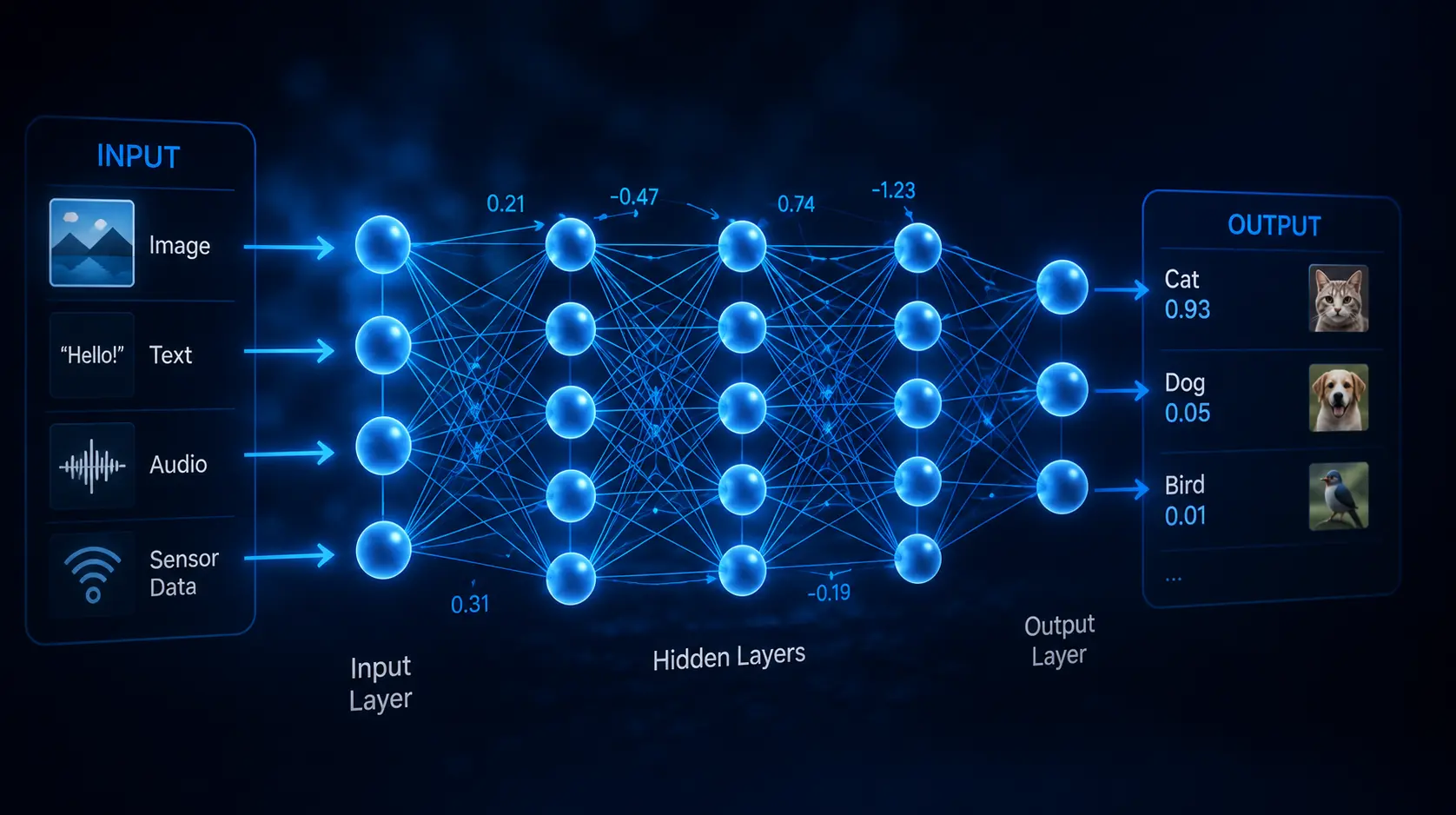
Artificial neural networks mimic this idea, but in math rather than biology. Picture an enormous network of numbers. Each individual "brain cell," or neuron, is nothing more than a number. Each link between brain cells has a weight a number that controls how much one cell influences another. When input data is provided (say, an image of a cat), these numbers process the information to produce an output ("cat").
So far, nothing magic. Just multiplication and addition, millions of times over.
The magic is in how those weights get set.
Learning
Training: How a Machine Learns Without Being Taught
Here's where it gets genuinely interesting. You don't program a neural network by hand. You train it. And training is, at its core, a process of making mistakes and correcting them over and over, at a scale no human could manage.
Take image recognition. You feed the network a million photos of cats and dogs, each one labelled. The network makes a guess: cat or dog? At first, it's essentially random — it might as well be flipping a coin. However, each time the machine guesses wrong, there is another technique known as backpropagation that goes back through the network and tweaks the weights to become a little bit less incorrect.
Do this millions of times and something remarkable happens. The network starts to notice patterns it was never explicitly told to look for. The pointy ears. The whiskers. The shape of a snout. Nobody programmed "look for ears." The network discovered that feature on its own, because ears turned out to be a reliable signal for getting the right answer.
This is the core insight of modern AI :
You don’t need to define the rules if you give the system enough examples and enough feedback.
Language Models
So When You're Chatting With an AI…
Large language models the technology behind ChatGPT, Claude, and similar tools take this idea to an almost absurd extreme.
They're trained on hundreds of billions of words, books, articles, code, conversations, websites essentially a large chunk of written human thought. And their training task is deceptively simple: predict the next word.
That's it.
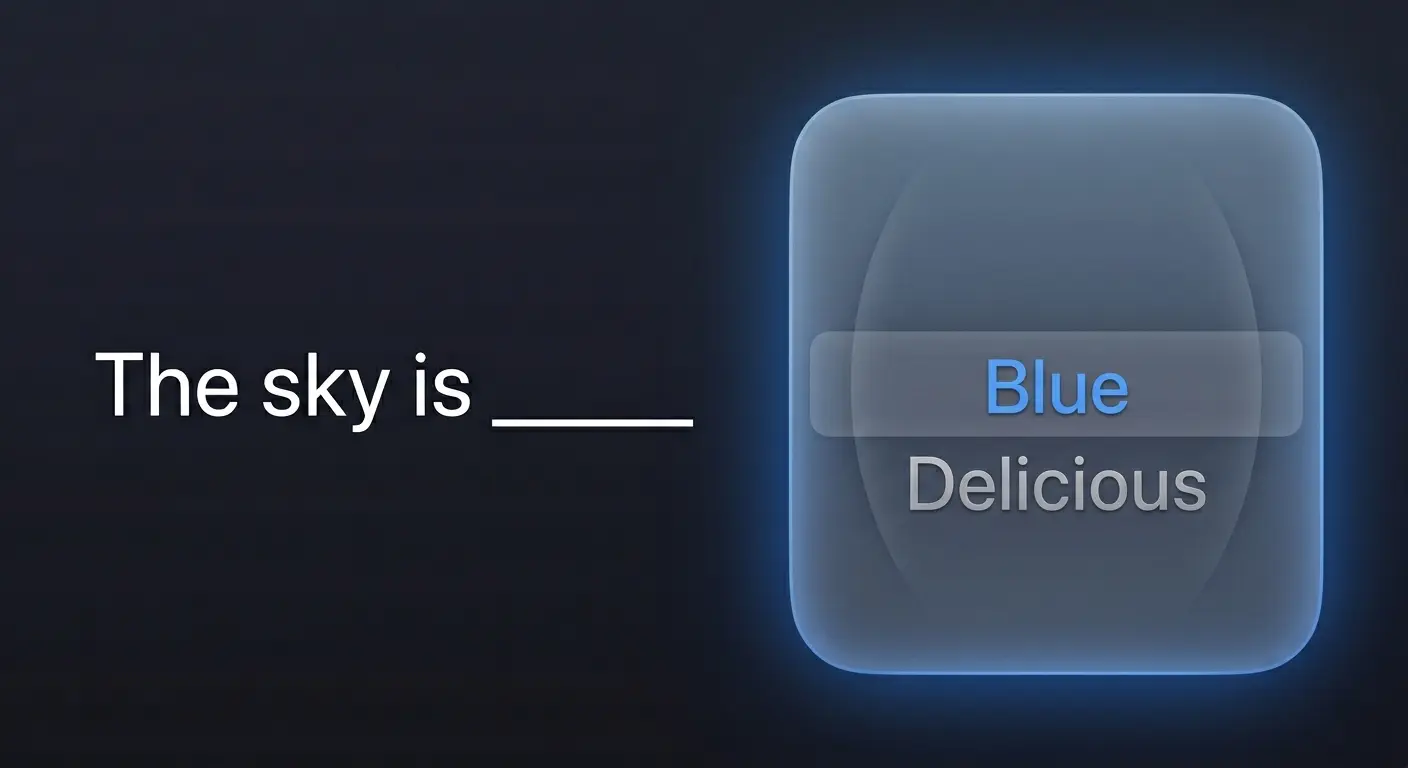
Given the phrase "The sky is," the model learns that "blue" is far more likely than "delicious." Given a complex sentence about quantum physics, it learns to produce something that sounds like a physicist wrote it because it has seen how physicists write.
What emerges from training on that much text isn't just autocomplete it's something that has implicitly learned grammar, facts, reasoning patterns, how to tell jokes, how to write code, and how to explain concepts. Not because anyone wrote those things in, but because they were the patterns that helped predict text accurately.
This is why talking to a modern AI feels so different from googling something. Google finds pages that contain your words. An AI has internalised the structure of how words relate to meaning — and generates a response from that internalised structure.
Common Misconception
The Part Most People Get Wrong
Here's the thing that trips up even technically sharp people.
AI doesn't know things the way you know things. When you know that Paris is the capital of France, there's a fact sitting in your head, linked to a map, linked to memories, linked to a vague image of the Eiffel Tower.
When an AI "knows" Paris is the capital of France, it's because the weights in its network make "Paris" an extremely high-probability response to any prompt involving "capital of France." It's a correlation learned from billions of examples not a fact consciously stored anywhere.
This is why AI can be confidently wrong. If a question is phrased in a way that resembles prompts where a wrong answer was common in the training data, the model will produce that wrong answer with complete confidence. It doesn't know it's wrong, because it doesn't know anything it's pattern-matching at an extraordinary scale.
It also means AI doesn't truly understand the words it uses. It understands the statistical relationships between them.
Whether that distinction ultimately matters whether understanding meaning and modelling meaning at sufficient scale become functionally the same thing is one of the most fascinating open questions in science right now. Researchers genuinely don't agree.
Real-World Impact
Why This Matters Beyond the Chatbot
You might be thinking: okay, interesting but why does it matter how the AI thinks, as long as it does useful things?
It matters because once you understand the mechanism, you understand both the power and the limits.
ThePower
Neural networks can find patterns in data that humans would never notice medical scans, equipment vibration, purchasing behaviour, network traffic.
TheLimits
It needs lots of data. It can be confidently wrong. It doesn't generalise beyond its training. And it cannot explain why it reached a conclusion.
This is exactly why combining AI with physical sensor systems like the kind we work with at Bluepixel is such a powerful combination. Sensors generate the raw data. AI finds the patterns. The hardware makes those patterns actionable in the real world.
A wearable that detects early signs of fatigue in a factory worker. A BLE sensor network that predicts equipment failure before it happens. A smart retail system that learns how customers move through a space. None of that works without AI understanding really understanding the data coming from the physical world.
The Short Version
AI thinks by finding patterns. It learns by making mistakes at scale. It doesn't store facts it stores statistical relationships so deeply embedded that they become indistinguishable from knowledge.
It's not magic. It's not conscious. And it's not going away.
What it is, is the most useful pattern-recognition engine ever built and we're still in the early days of figuring out what to do with it.
Building AI Into the Real World Is What We Do
Understanding how AI thinks is one thing. Deploying it in production IoT systems where sensors, firmware, mobile apps, and machine learning pipelines all have to work together seamlessly is something else entirely.
At Bluepixel Technologies, we bridge the gap between AI intelligence and physical hardware. Whether you’re building a wearable that needs on-device inference, a factory sensor network with predictive analytics, or a smart retail system that learns from customer behaviour we design and build the full stack, from the hardware up.