

GPS Stops at the Door: The Future of Indoor Asset Tracking

- Aug 05, 2026 |
- By Kirti Sharma - Bluepixel Team

GPS Stops at the Door: The Future of Indoor Asset Tracking
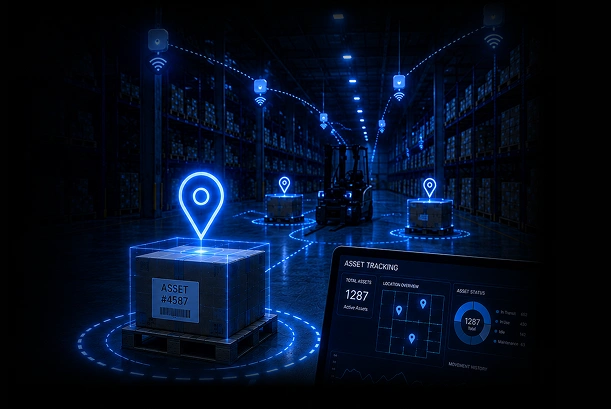
Walk into any modern logistics warehouse, hospital, or manufacturing floor and you will find a hidden inefficiency that GPS cannot solve. Somewhere in that facility, a ventilator is sitting in the wrong ward. A forklift is idle at the wrong dock. A tool worth thousands of dollars was last seen three days ago on the fourth floor.
GPS, the technology that guides ships across oceans and routes taxis through city streets, goes completely blind the moment it crosses the threshold of a building. Radio signals from satellites 20,000 kilometres above the Earth simply cannot penetrate steel, concrete, and dense flooring. The signal is lost. And with it, so is visibility into the assets that keep operations running.
Organisations lose an average of 15–20% of their movable assets each year to misplacement, theft, and untracked movement, not because the assets are gone, but because nobody knows where they are.
This is not a niche problem. It affects every industry that operates inside buildings at scale. And as organisations move toward digital operations, the inability to answer a simple question that where is this asset right now, is becoming one of the most costly gaps in operational intelligence.
Indoor asset tracking exists to close that gap. And it is advancing faster than most organisations realise.
Why GPS Fails Indoors
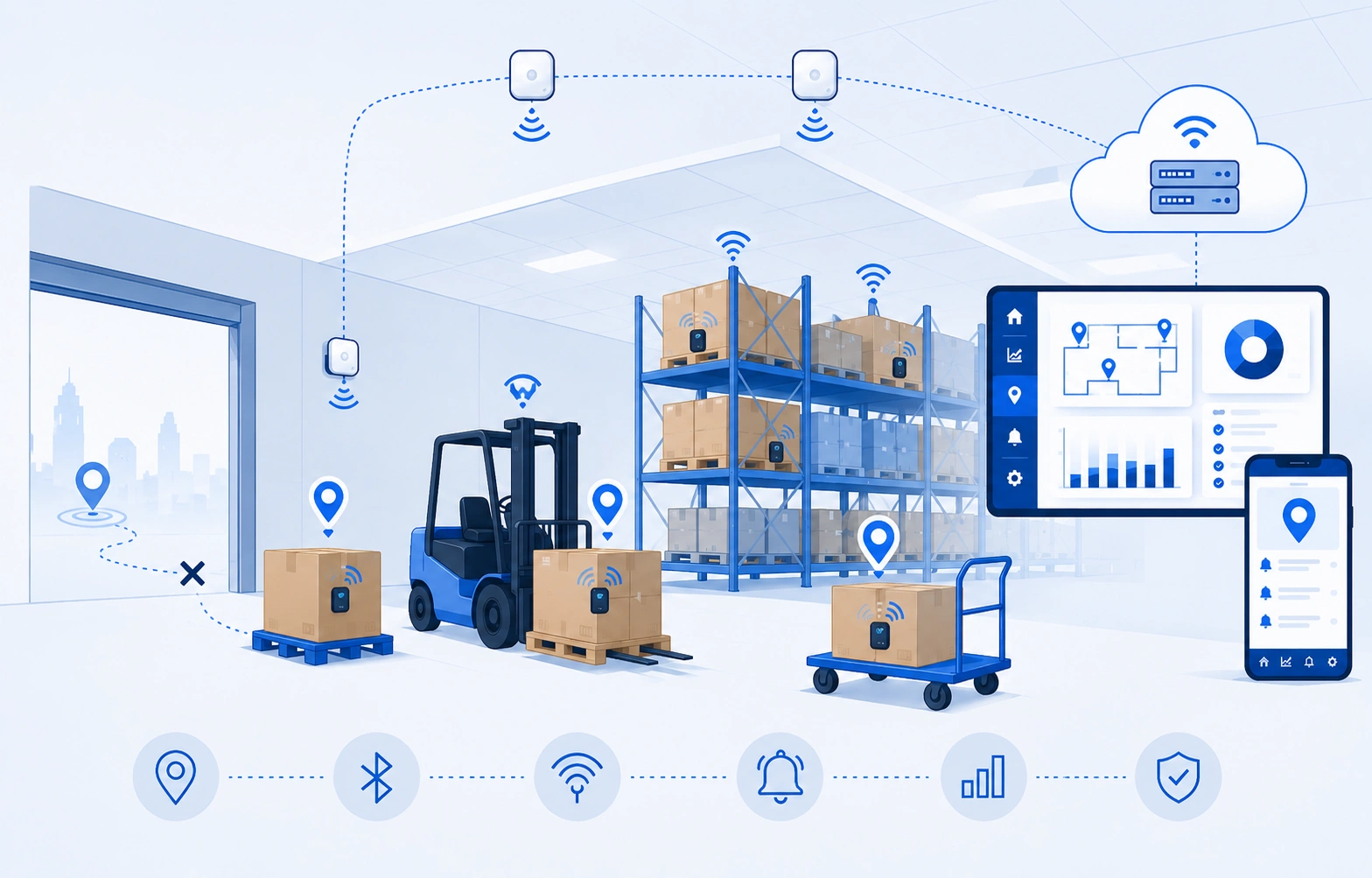
GPS is a line-of-sight technology. Satellites broadcast signals that travel well through open sky but struggle with physical obstructions. Inside a building, those signals are reflected, scattered, and blocked by walls, metal shelving, machinery, and the building structure itself.
Even in the rare cases where a GPS signal does reach an indoor receiver, it arrives so degraded that the resulting position estimate can be off by tens of metres, often placing the device in an adjacent room, on the wrong floor, or outside the building entirely.

Structural interference
Steel frames, reinforced concrete, and dense flooring absorb and reflect GPS radio waves before they can reach a receiver.

Multipath propagation
Signals that do penetrate a building bounce off interior surfaces, arriving at the receiver from multiple directions simultaneously.

No vertical resolution
Even outdoor GPS struggles with altitude. Inside multi-story buildings, GPS typically lacks the vertical accuracy required to determine floor level.
The solution is not to improve GPS for indoor use. It is to complement it with purpose-built RTLS that works with the physics of enclosed spaces. RTLS does not replace GPS, it extends location intelligence from the car park to the ward, from the loading dock to the warehouse floor, from the yard to the factory cell.
The Four Technologies Powering Indoor Tracking
There is no single indoor tracking technology that works everywhere for everything. The right choice depends on the required accuracy, the size of the facility, the number of assets, the acceptable infrastructure cost, and whether real-time or periodic location is sufficient. Here is how the leading technologies compare.
Bluetooth Low Energy (BLE 5.x)
How it works:
BLE beacons broadcast a unique identifier at regular intervals. Fixed receivers that are mounted on walls or ceilings, pick up these broadcasts and use signal strength (RSSI) or, in newer BLE 5.1+ systems, angle of arrival (AoA) to calculate position. Multiple receivers estimate the asset's position using RSSI, trilateration, fingerprinting, or AoA depending on the deployment.
1–3 Typical accuracy:
metres with RSSI trilateration. Sub-metre with AoA and a dense anchor grid.
Best suited for:
Hospitals tracking equipment and patients, large warehouses tracking inventory, retail environments, and any deployment where scale and cost are the primary constraints. A BLE beacon on a coin cell can last 1–3 years on a single charge, making it practical at very high asset volumes.
For a hospital managing 2,000 pieces of mobile equipment, BLE RTLS means nurses stop searching and start treating. Equipment utilisation rises, procurement of duplicate assets falls, and maintenance schedule compliance becomes automatable.
Ultra-Wideband (UWB)
How it works:
UWB transmits extremely short, low-power radio pulses across a wide frequency band (typically 3.1–10.6 GHz). The time it takes for a pulse to travel from a tag to an anchor, measured to nanosecond precision, is used to calculate exact distance. Multiple anchors produce centimetre-accurate 3D coordinates.
Typical accuracy:
10–30 centimetres. Best-in-class for indoor positioning, and highly resistant to multipath interference due to its wide bandwidth.
Best suited for:
High-value surgical equipment, robotic warehouse systems, industrial safety (worker proximity to hazardous machinery), precision manufacturing, and any application where a one-metre error is operationally unacceptable.
For a manufacturer tracking tools near hazardous machinery, the difference between one metre and ten centimetres is a safety incident avoided. UWB-based exclusion zone enforcement can trigger automated machinery pauses before a worker is within danger range.
RFID - Passive and Active
How it works:
Passive RFID tags contain no battery. A reader emits radio energy that powers the tag inductively; the tag reflects back its unique identifier. Active RFID tags carry their own power source, extending range significantly and enabling real-time location updates.
Passive RFID:
Read range of up to 3 metres. Provides zone-level awareness by indicating that this item passed through this doorway, rather than providing precise coordinates.
Active RFID:
Read range up to 100 metres. Can provide approximate location (3–5 metre accuracy) by identifying which reader detected the tag.
Best suited for:
Supply chain tagging, inventory management, access control, tool tracking in fixed locations, and any use case requiring very low cost per tag at high volumes.
For a retailer running quarterly inventory audits, passive RFID replaces three days of manual counting with a few hours of reader sweeps. Reported reductions in inventory audit time of up to 80% are widely documented. (Source: Auburn RFID Lab research series.)
Wi-Fi RTLS
How it works:
Wi-Fi RTLS tags or devices communicate with existing access points. The system estimates position using RSSI-based trilateration, radio fingerprinting, Time Difference of Arrival (TDoA), or Channel State Information (CSI). Modern systems using Wi-Fi 6 and Fine Timing Measurement (FTM) achieve significantly better accuracy than earlier RSSI-only generations.
Typical accuracy:
3–15 metres depending on access point density and generation.
Best suited for:
Enterprise campuses with dense Wi-Fi coverage, facilities where deploying a separate RTLS network is cost-prohibitive, and mixed environments where some assets already have Wi-Fi chipsets.
For an enterprise campus already running dense managed Wi-Fi, RTLS becomes a location intelligence capability added at marginal incremental cost, with no separate radio infrastructure required.
At a Glance: How the Technologies Compare
| Technology | Range | Accuracy | Best For | Cost |
|---|---|---|---|---|
| BLE 5.x | 1–30 m | 1–3 m | Hospitals, retail, large warehouses | Low |
| UWB | 0–50 m | 10–30 cm | High-value assets, robotics, surgical tools | High |
| RFID (Passive) | 0–3 m | Zone-level | Inventory tagging, supply chain | Very Low |
| RFID (Active) | 0–100 m | 3–5 m | Large facilities, vehicle tracking | Medium |
| Wi-Fi RTLS | 30–50 m | 3–15 m | Enterprise campuses, existing infra reuse | Medium |
The right technology is not the most accurate one it is the most accurate one that your operational context, budget, and infrastructure can support.
Why the Best Systems Use More Than One Technology
Real facilities are not uniform environments. A hospital has long open corridors, small equipment bays, sterile theatres, and multi-story logistics lifts. A factory has open floor space, enclosed machine cells, outdoor yard areas, and loading docks. No single technology excels across all of these environments simultaneously.
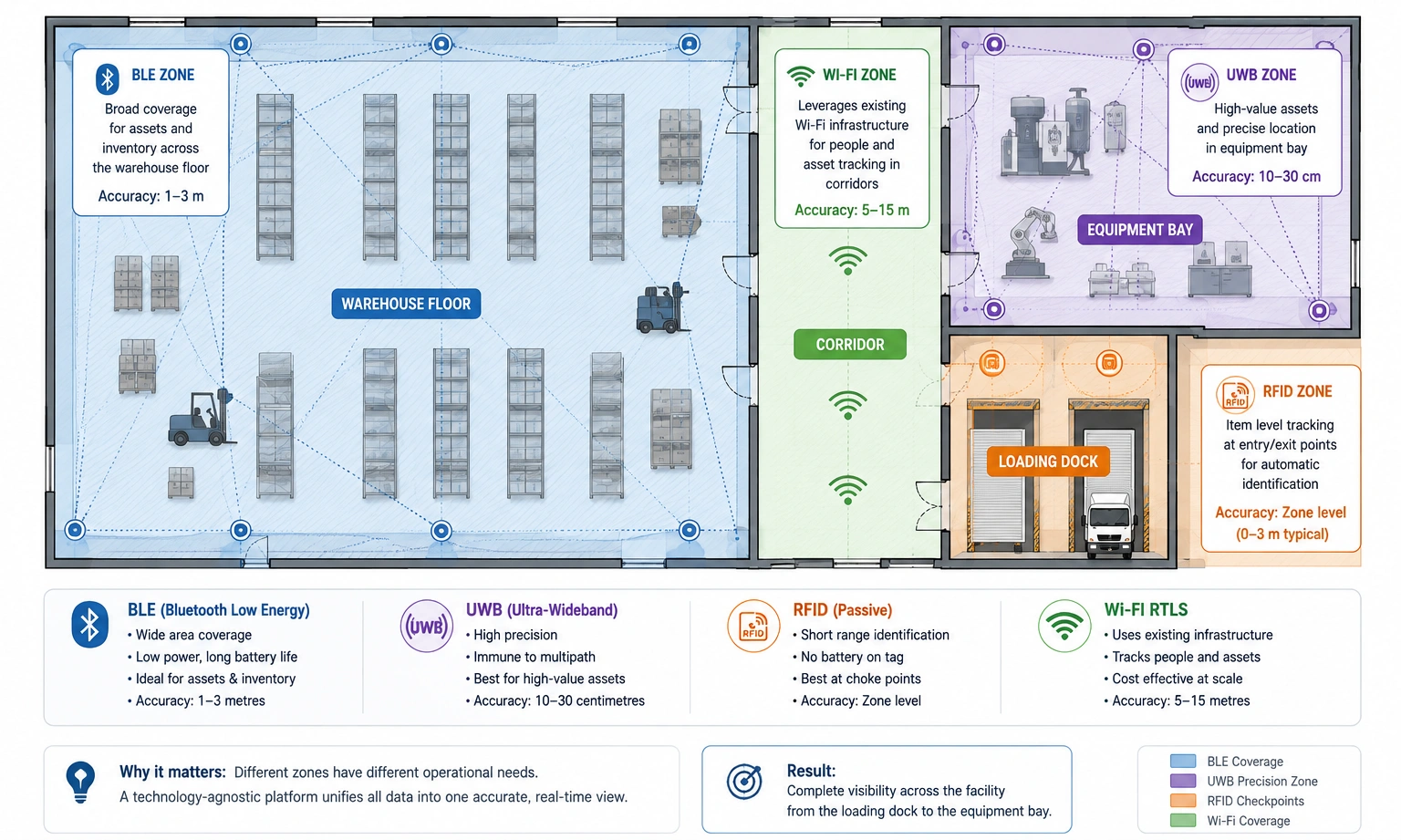
The most effective indoor asset tracking deployments combine technologies to cover their respective weaknesses:
BLE + UWB
General asset tracking at scale with precision tracking for the highest-value subset of assets
BLE + RFID
Real-time tracking of large equipment combined with high-volume passive tagging of consumables and inventory
Wi-Fi + BLE
Leveraging existing network infrastructure for coverage, using BLE gateways for higher accuracy in key zones
UWB + GPS
Seamless handoff from outdoor GPS to indoor UWB as an asset moves through the facility boundary
The critical design decision is not which technology to use, it is how to unify the data streams from multiple technologies into a single location intelligence platform, and how to ensure that platform remains accurate as the facility changes over time.
Industry Use Cases: Location Intelligence in Practice

Healthcare
Hospitals using BLE asset tracking report 20–30% reductions in time nurses spend searching for equipment. UWB is increasingly used for surgical instrument tracking and infant security.
Impact: Reported impact: up to 30% reduction in equipment search time.

Manufacturing
UWB-based proximity detection alerts workers when they approach hazardous zones. Tool tracking eliminates manual check-out processes and ensures the right tool reaches the right station.
Impact: near-zero safety incidents in UWB-equipped zones

Warehousing & Logistics
BLE and RFID track pallets, trolleys, and inventory through fulfilment centres. Real-time location data feeds directly into WMS systems, reducing mis-picks and misrouted shipments.
Impact: 15–25% improvement in pick accuracy reported

Airports
Ground support equipment such as tugs, jetways, baggage carts are tracked across aprons using hybrid BLE and GPS, with indoor coverage extending into terminals and baggage halls.
Impact: faster turnaround, reduced equipment search time

Retail
High-value merchandise is tracked throughout stockrooms and on the shop floor using passive RFID, reducing shrinkage and enabling faster inventory audits without manual counting.
Impact: RFID reduces inventory audit time by up to 80%

Construction
Tools, heavy equipment, and materials are tracked across large, constantly-changing sites using active RFID and BLE, reducing theft and ensuring compliance with safety regulations.
Impact: 25–40% reduction in tool loss reported on tracked sites
The Backend: Where Location Data Becomes Intelligence
Choosing the right radio technology is the first decision. Making that technology operationally useful is the harder problem.
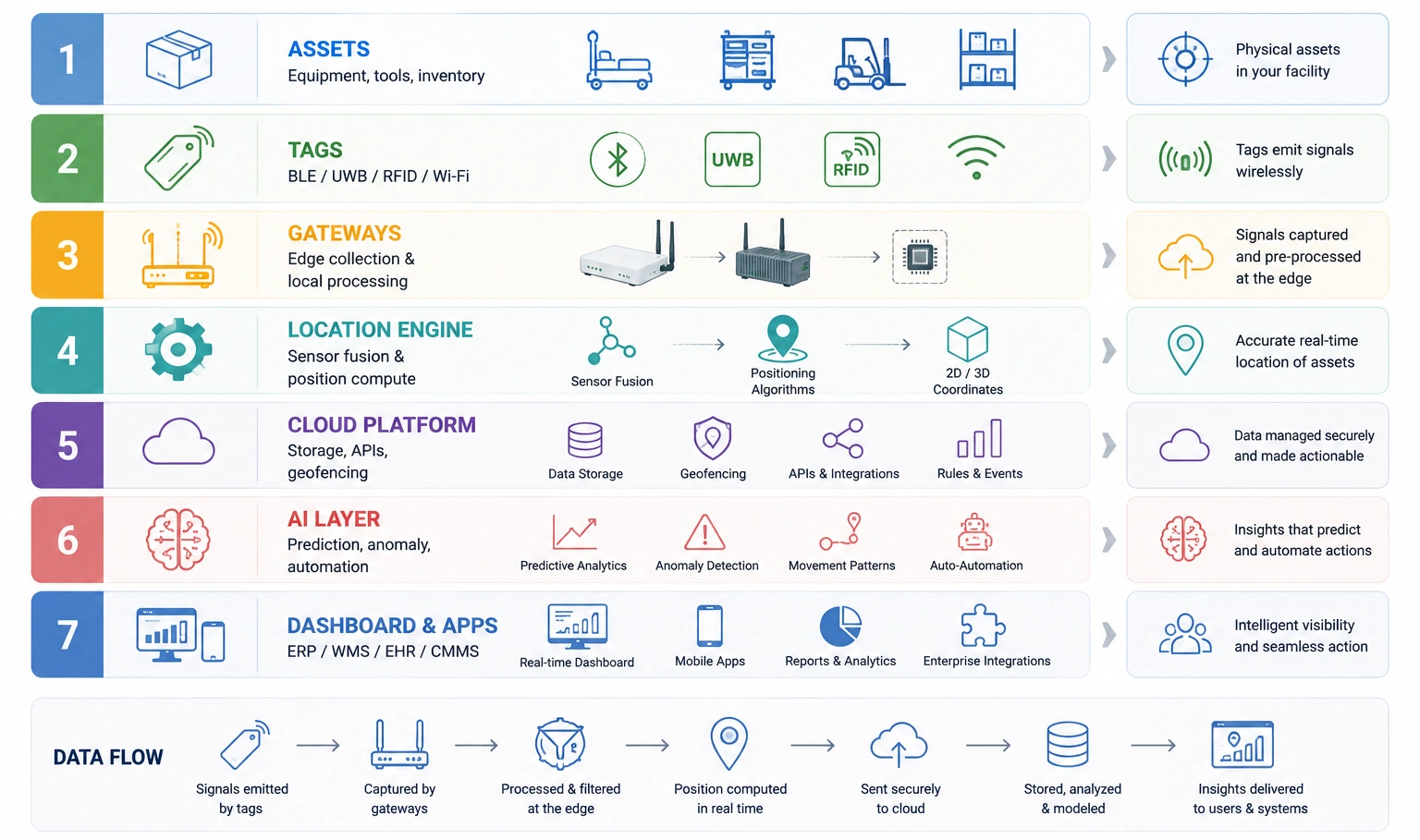
A BLE gateway network generates thousands of location events per minute. A UWB system tracking 500 assets updates position 10 times per second. Raw data volume is immense, and raw data is not operational intelligence. It needs to be:
- Ingested reliably without data loss under burst conditions
- Deduped and filtered to produce clean, accurate position estimates
- Fused across multiple radio technologies where hybrid deployments exist
- Stored efficiently for both real-time queries and historical analysis
- Surfaced through APIs and dashboards that reflect asset positions within seconds of movement
Common failure
Most indoor tracking pilots succeed. Most indoor tracking deployments at scale fail, not because of the hardware, but because the backend was not built for the data volume that a live facility generates at full device density.
The backend architecture for an indoor tracking system is, in most respects, a harder problem than the one we described in the context of IoT backends generally. It has all of the same scaling challenges, including burst ingestion, stateful device management, latency-sensitive processing. In addition, it must support sensor fusion, floor plan integration, and geofence evaluation. .
Getting the hardware right gets you 40% of the way to operational indoor tracking. The backend gets you the rest.
The Indoor Asset Tracking Architecture Stack
What Good Indoor Tracking Actually Looks Like
An indoor asset tracking system that is working well is invisible to the people who use it. Nobody is scanning barcodes. Nobody is calling around asking where the equipment went. Nobody is filing lost-asset reports.
Instead, the right person sees the right information without asking for it:
- A ward manager sees every ventilator in the hospital, colour-coded by floor and availability, updated every 30 seconds. If a ventilator has not moved in 72 hours, it is flagged automatically.
- A warehouse supervisor sees every pallet in the facility and can trace its movement history over the past seven days. When an order is delayed, the reason is visible in seconds.
- A factory safety system alerts automatically when a worker's UWB tag enters a hazardous exclusion zone, triggering a machinery pause before the worker is within two metres of the hazard.
The measure of a successful indoor tracking deployment is not the accuracy of the positioning. It is whether the organisation changes how it operates because of the data it now has.
This is the difference between an indoor tracking pilot and an indoor tracking capability. The technology enables the capability. The system design determines whether the capability is ever reached.
The Door Is No Longer the Edge of Visibility
GPS changed outdoor logistics permanently. Indoor location intelligence is doing the same thing for the 80% of operational space that GPS cannot see. The technologies exist, they are mature, and the economics are becoming compelling across a widening range of industries.
The organisations building this capability now are not doing so because it is fashionable. They are doing so because the cost of not knowing where things are, in terms of lost time, lost equipment, and lost efficiency, is finally being measured and taken seriously.
Indoor asset tracking does not require a long, risky technology replacement cycle. It requires the right sensor technology chosen for the right environment, connected to a backend that can turn location events into operational intelligence, along with a partner who has done this before.
What comes next goes further still. The next generation of indoor tracking will combine AI, digital twins, computer vision, and real-time location systems to predict asset movement, optimize workflows, and automate decisions.
The shift underway is from reactive visibility to predictive intelligence, systems that surface the right asset, at the right place, before the need is even expressed. Asset location becomes an input to AI-driven operational decisions, not just an answer to a search query. Organisations will compete not on knowing where an asset is, but on how intelligently they act on that information.
Ready to extend visibility beyond the door?
Bluepixel Technologies develops enterprise-grade BLE, RFID, UWB, IoT, mobile, cloud, dashboard, and AI-powered solutions tailored to healthcare, logistics, manufacturing, retail, and smart facilities. If your organisation is ready to move from GPS blind spots to full indoor location intelligence at any scale, we can help you design and build the right system from the ground up.
Share Article
Linkedin
Facebook
Copy link
Recent Blogs



Share Article
Linkedin
Facebook
Copy link