

Why IoT Devices Function Flawlessly in the Lab but Fail in the Real World

- Sept 09, 2026 |
- By Rushikesh Sanghani - Bluepixel Team

Why IoT Devices Function Flawlessly in the Lab but Fail in the Real World
The Pilot That Wasn't
Six weeks. It took a mid-size logistics company six weeks to go from "this is going to change everything" to "why is nobody talking to us?"
Testing had gone perfectly well. Fifty sensors, happily chirping away in a temperature-controlled room on a bench for three whole weeks. They reported flawlessly every thirty seconds with perfect battery levels. The whole team went into celebrations, signed off on the launch, and sent the sensors to refrigerated trucks in three different states.
After ten days, one-third of them went silent.
Not faulty. Not dead. Just... silent. Some of them were sending readings that did not make any sense: a truck showing temperature readings of 140°F, while the driver was sure he could still taste the warmth of his coffee after two hours. Others stopped reporting anything at all, having been last seen on the shoulder of the highway without a single connection to a cell tower.
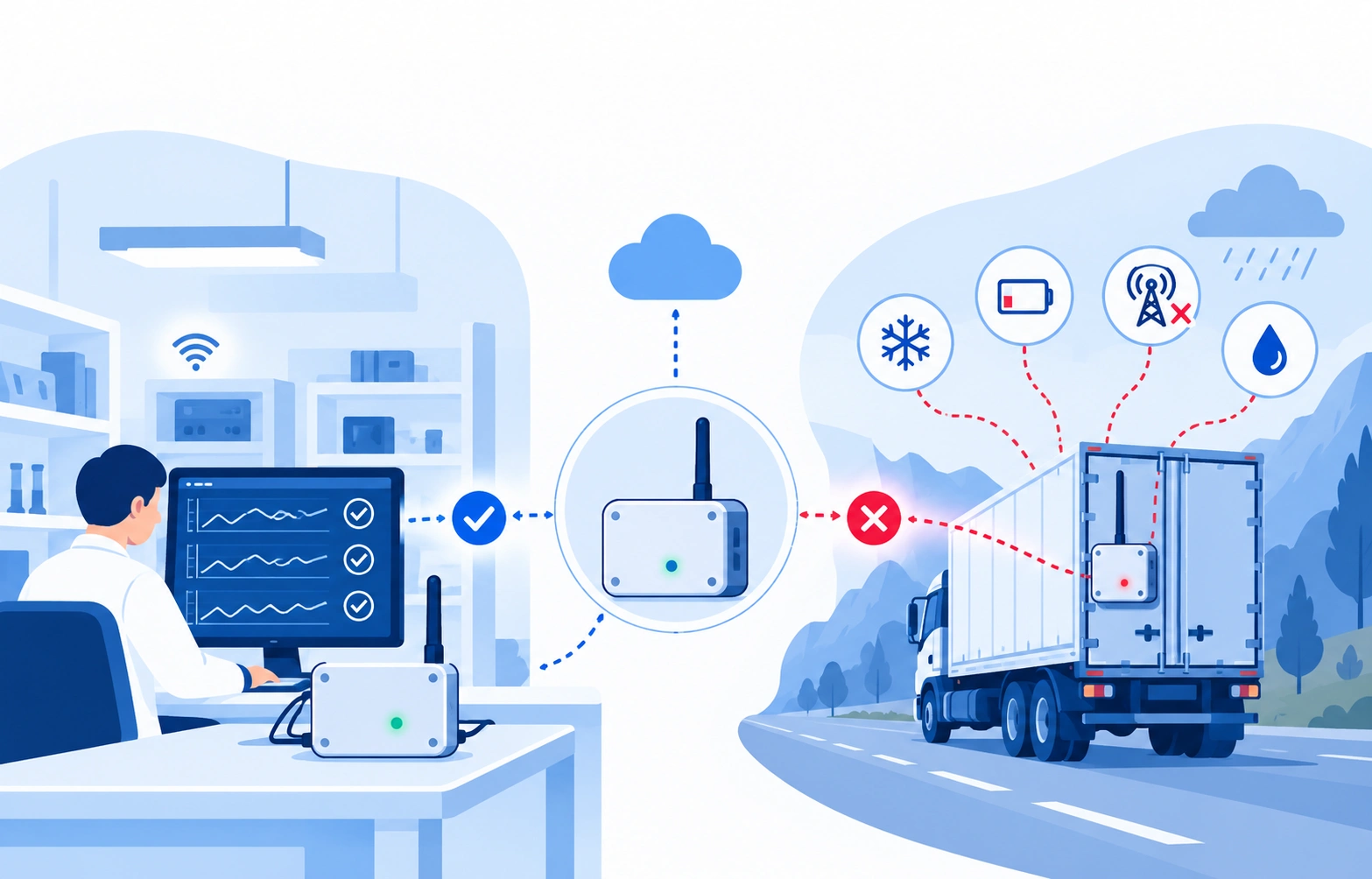
The issue was due to several factors that no one had ever considered: trucks of cold-chain transportation with steel walls blocking the radio signal, temperature changes draining lithium batteries much faster than any specification sheet said and some kind of software bug that triggered itself if the device lost connection for longer than four hours something that had never happened in the laboratory, as the lab always had Wi-Fi.
But this situation is not unique. It is almost a standard rite of passage in our industry. And it shows an inevitable truth that we all have to face at some point when working with connected devices: the lab is not the world.
Why the Gap Exists in the First Place
The lab is intentionally the antithesis of the real world. It's quiet, temperature-controlled, electromagnetically calm, and populated by individuals who understand precisely what the device is supposed to do. Engineers validate the happy path because it validates the basic concept. This isn't an error; it's a necessary step in the process. The issue occurs when engineers take "it works in the lab" and turn it into "we can ship it."
Here are the particular methods through which the real world will put a device that passed the bench test in its place.
RF Interference: The Invisible Wall
Radio waves don’t really care about your roadmap. In the lab, the radio wave is transmitted through empty air space, perhaps in the presence of a couple of laptops. Out there in the field, it has to penetrate all that concrete, steel shipping containers, motors, competing wireless signals, and in many cases, competing signals of another neighbouring company’s equipment.
Warehouses are known for this problem. Racks become Faraday cages. Forklift motors generate electromagnetic interference that can completely overwhelm the radio wave. A sensor that was perfectly connected at fifteen meters on the lab bench may struggle to connect to a gateway just five meters away in the warehouse.
Battery Life: The Datasheet Lied (Sort Of)
The specifications of batteries are tested under perfect conditions at room temperature, with a known duty cycle. Neither is ever available in real-life application. Cold temperatures alone can reduce lithium battery capacity to 20-50%. Direct exposure to the sun will heat the device, causing the power management system to kick in with a conservative approach, which will result in unnecessary depletion of battery power.
And there’s the duty cycle issue. The device, designed to function according to “a sleep-transmit-sleep” cycle every ten minutes, is forced to send the message again and again in case it was not successfully transmitted due to a dead zone. In the lab setting, there were no problems with transmissions.
Environmental Stress: Nature Doesn't Read Spec Sheets
Humidity, vibration, dust, thermal cycling, and ultraviolet light these are not special cases; they are simply another day at work. An enclosure built to withstand outdoor conditions might still allow enough condensation to seep into the device to cause corrosion on an otherwise secure connection after just one season. The vibration caused by a delivery truck could cause the loosening of an antenna connection originally made in the manufacturing process.
Connectivity Gaps: The World Isn't Always Online
This is something that is rarely simulated honestly in the lab environment. Connectivity is not a stable thing in the real world. It is intermittent, seasonal, and even absent at times. Coverage is lost in rural areas. Ships lose their satellite connections somewhere out at sea. Basements lack all connections. A device design that depends on "try again until you get connected" risks killing batteries or losing data.
Firmware Edge Cases: The Bugs You Never Meet on Purpose
These firmware problems flourish in rare situations such as memory leaks that happen only after running for 72 hours without stopping, race conditions that are activated only when two sensors connect back to the gateway within one second, clock drift that only makes sense after months of operation. In the lab tests, due to limitations of time and money, these conditions cannot be found.
Deployment Mistakes: The Human Factor
It may be that the equipment itself is perfect but that the implementation process is faulty. Equipment gets installed incorrectly, such as in a certain orientation that doesn’t allow it to function properly; antennas are put into metal boxes “as it seemed tidier, technicians don’t calibrate the equipment because the instructions are confusing; or nobody considers that the installer in the field will not have the same resources and attention to detail as an engineer wearing a lab coat.
Lab vs. Field: A Quick Comparison
| Factor | In the Lab | In the Field |
|---|---|---|
| Signal environment | Open air, minimal obstructions | Steel, concrete, machinery, competing signals |
| Temperature | Stable, room temperature | Extreme swings, direct sun, cold storage |
| Connectivity | Constant, high-bandwidth Wi-Fi | Patchy, seasonal, sometimes absent |
| Power source | Often mains-powered or fresh batteries | Ageing batteries, extreme temperature drain |
| Uptime tested | Days to weeks | Needs to survive months to years |
| Operators | Trained engineers | Field techs, non-technical staff, sometimes no one |
| Physical stress | None | Vibration, dust, moisture, impact |
| Failure visibility | Immediate, on the bench | Delayed, discovered days or weeks later |

The Mindset Shift That Actually Fixes This
It's not about improving the antenna or extending the battery life; it's about a change in mindset. It has been proven in labs that a technology works. It has to be proven in the field that the technology works well despite uncontrollable conditions. Thinking of field testing as a routine procedure instead of a science is what makes most IoT projects fail behind the scenes.
Field testing implies performing the test in the real environment where the device will operate. This includes creating chaos intentionally: disrupting the signal while transmitting the information, exposing devices to extreme temperatures, and leaving installation of devices to regular people. And developing the firmware that operates under the assumption that failure is the norm rather than an exception.
A Field-Testing Checklist Worth Stealing
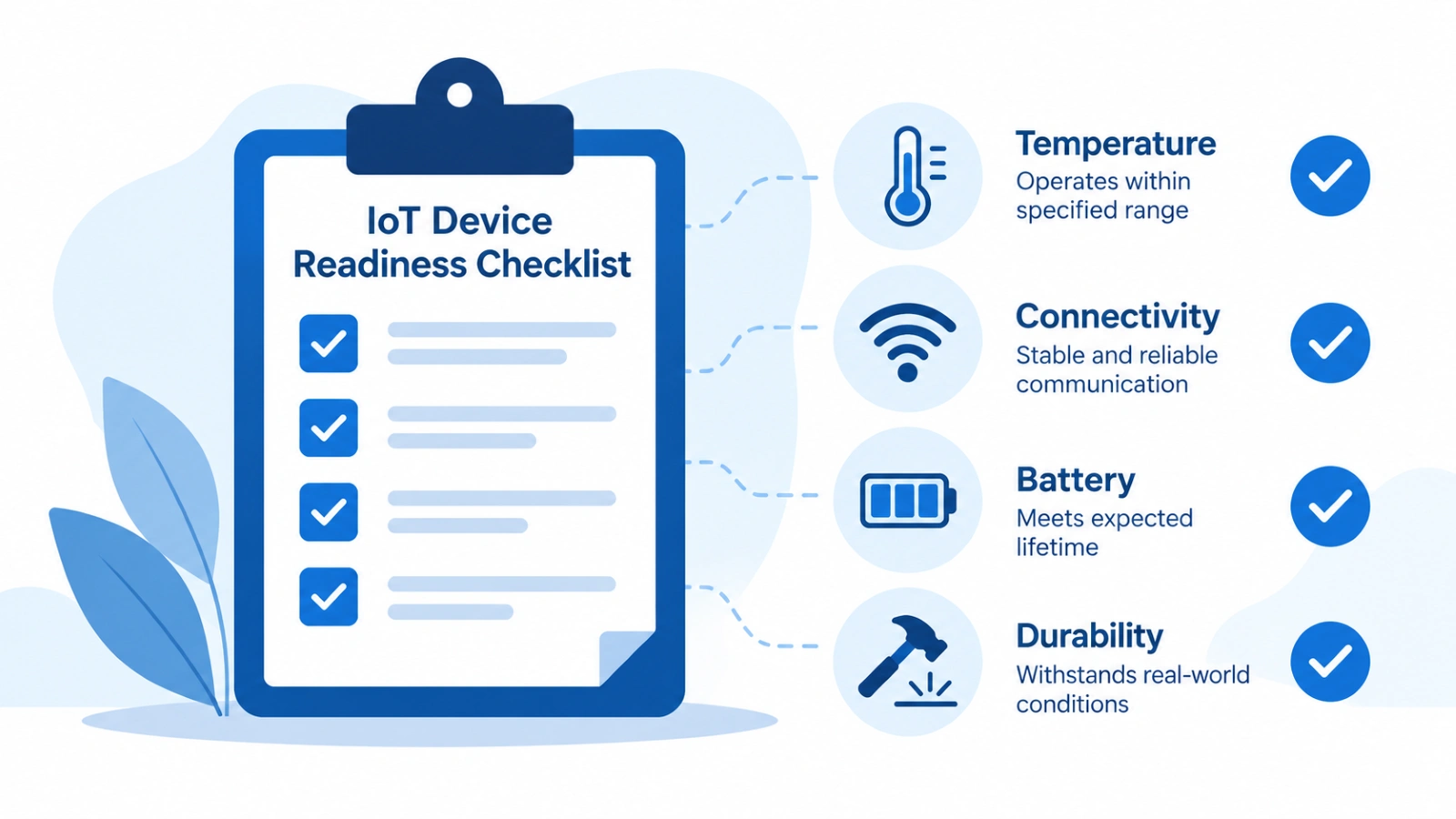
It is always prudent to have a checklist such as this one before rolling out an IoT project from pilot to production:
- Test in the real environment, not a proxy for it: the actual warehouse, the actual truck, the actual weather
- Simulate connectivity loss deliberately, for hours at a time, not just seconds
- Run devices through full temperature extremes they'll realistically face, not just the "typical" range
- Let the battery run down naturally under real duty cycles instead of just checking the spec
- Have a non-engineer install a unit and watch where they get confused
- Stress-test firmware over weeks, not days, watching for slow leaks and drift
- Physically abuse a few units, drop them, shake them, get them wet, before trusting the rest
- Plan for graceful degradation, not just perfect connectivity, so a device fails safely instead of silently
It’s not as quick or gratifying as seeing lights turn green on a dashboard in an office environment. However, it’s the difference between a scalable pilot and a pilot that dies out after six weeks.
Building for the World You'll Actually Deploy Into
It is not a flaw in the process of engineering, but it is a problem that was known to be a predictable one all along, and only the discipline of the engineers allows us to address it right from the very beginning. It's not about the most spectacular demo in the lab; it is about treating the real world as a test bench from the very beginning of the project.
This is our daily routine at Bluepixel Technologies: we design, test, and harden the IoT devices, making sure they will last long enough when they are no longer on the bench of the lab. And if you are developing an IoT device, you might want to get in touch with us.
Explore our IoT development expertise and let's build something that works where it actually matters out in the real world.
Share Article
Linkedin
Facebook
Copy link
Recent Blogs



August 19, 2026

Share Article
Linkedin
Facebook
Copy link