

Smart and Sustainable: IoT Cold Storage
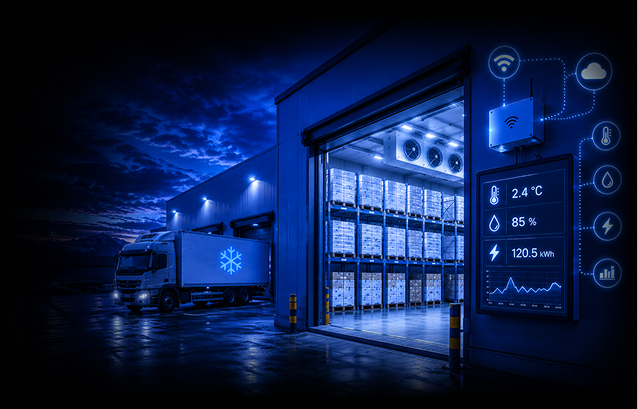


Revolutionizing Cold Storage with IoT
Smart and Sustainable: IoT Cold Storage
In the era of technological advancements, IoT cold storage is transforming how industries monitor and manage perishable goods. Leveraging connected devices, this technology offers precision and efficiency, enhancing the storage and handling of sensitive products, particularly in the pharmaceutical and Agricultural sectors.
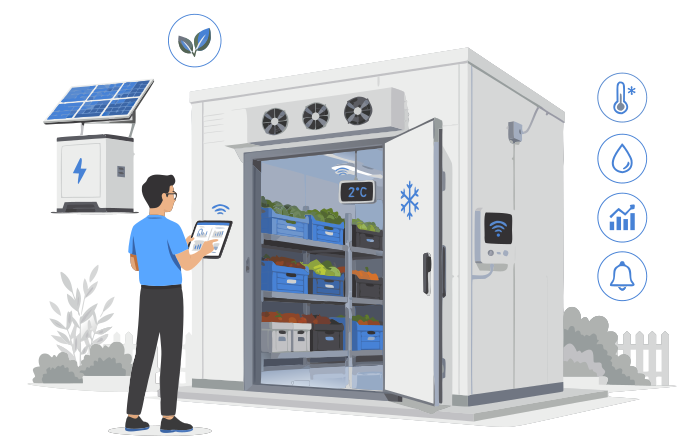
Key Benefits
Usage and Popularity:
IoT cold storage is increasingly popular in developed countries like the USA, Germany, and Japan, where the logistics and agriculture sectors are highly technologically integrated.

Real-Time Monitoring
Instant access to storage conditions, allowing for immediate adjustments.

Enhanced Efficiency
Automated systems reduce the need for manual checks and maintenance.

Reduced Waste
Better temperature control means fewer spoiled products.
How IoT Cold Storage Works?
In IoT smart cold storage, several key technologies are employed to ensure efficient environmental monitoring, management, and control. These technologies primarily revolve around sensors, connectivity protocols, data processing, and analytics. Here are the main IoT technologies used in smart cold storage
- Sensors are installed throughout the storage unit to monitor various parameters like temperature, humidity, door status, and gas levels.
- Data from these sensors is collected continuously to ensure real-time monitoring.
- The collected data is transmitted to a central system using various connectivity protocols such as Wi-Fi, Zigbee, Bluetooth Low Energy (BLE), LoRaWAN, NB-IoT, or 5G.
- Gateways aggregate data from multiple sensors and transmit it to cloud servers or central monitoring systems.
- Edge Computing processes data locally at the sensor or gateway level to reduce latency and bandwidth usage.
- Cloud Computing stores large amounts of data and runs complex analytics and machine learning models to predict maintenance needs and optimize operations.
- Machine Learning and AI analyze data to predict equipment failures, optimize energy usage, and improve overall efficiency.
Types of IoT Cold Storage and Their Technology
While the basic working of IoT cold storage is consistent, the size and scale of the operation determine the specific technologies used and their applications. Here's a look at different types of IoT cold storage based on size:
Small Cold Storages
- Use Case: Small businesses, restaurants, grocery stores, small-scale farmers.
- Technology Used: Wi-Fi, BLE; Temperature, humidity, door sensors; Edge computing.
- Industries: Food and beverage, pharmaceuticals, agriculture.
- Example: A small grocery store uses a Wi-Fi-enabled temperature sensor to monitor its refrigerated section.
Medium Cold Storages
- Use Case: Medium-sized enterprises, regional distribution centers, and medium-scale food processing units.
- Technology Used: Wi-Fi, Zigbee, NB-IoT; Temperature, humidity, door sensors, gas sensors; Edge and cloud computing.
- Industries: Food processing, pharmaceuticals, logistics.
- Example: A regional food distributor using Zigbee sensors and NB-IoT connectivity to monitor and control multiple cold storage units.
Large Warehouse Cold Storages
- Use Case: Large enterprises, national and international distribution centers, and large-scale food processors.
- Technology Used: LoRaWAN, NB-IoT, 5G; Comprehensive sensor networks; Cloud computing with advanced analytics.
- Industries: National and international logistics, large-scale food processing, pharmaceuticals.
- Example: A global pharmaceutical company using 5G and LoRaWAN to manage and monitor cold storage warehouses across multiple locations.
Share Article
Linkedin
Facebook
Copy link
Recent Blogs

July 15, 2026

Share Article
Linkedin
Facebook
Copy link