Why IoT Platforms Fail at Scale: And the Architecture Problems Most Teams Discover Too Late
July 08, 2026 |
By Kirti Sharma - Bluepixel Team
The Scaling Problems That Appear After Your IoT Product Goes Live
A team we spoke to recently had spent four months building a fleet management platform. Clean architecture, well-reviewed code, serverless backend on AWS Lambda. Their staging environment handled everything they threw at it.
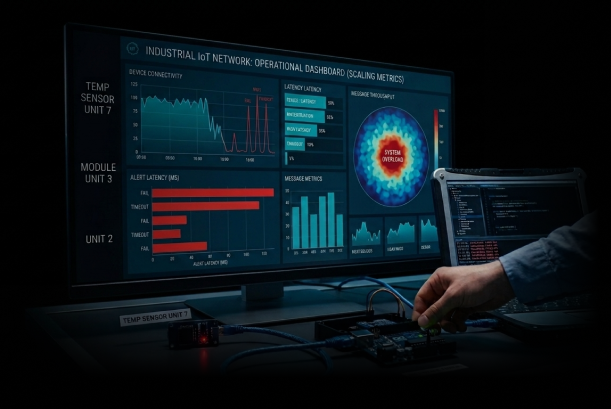
They launched. Within two weeks of connecting their first few hundred GPS and cellular-connected devices in the field, three things happened:
1. Sensor readings started disappearing from the dashboard, and no throttle alerts had been configured to catch the issue.
2. Alert notifications began arriving 1 to 3 seconds after the triggering event.
3. Their AWS bill for the month came in at four times what they had budgeted.
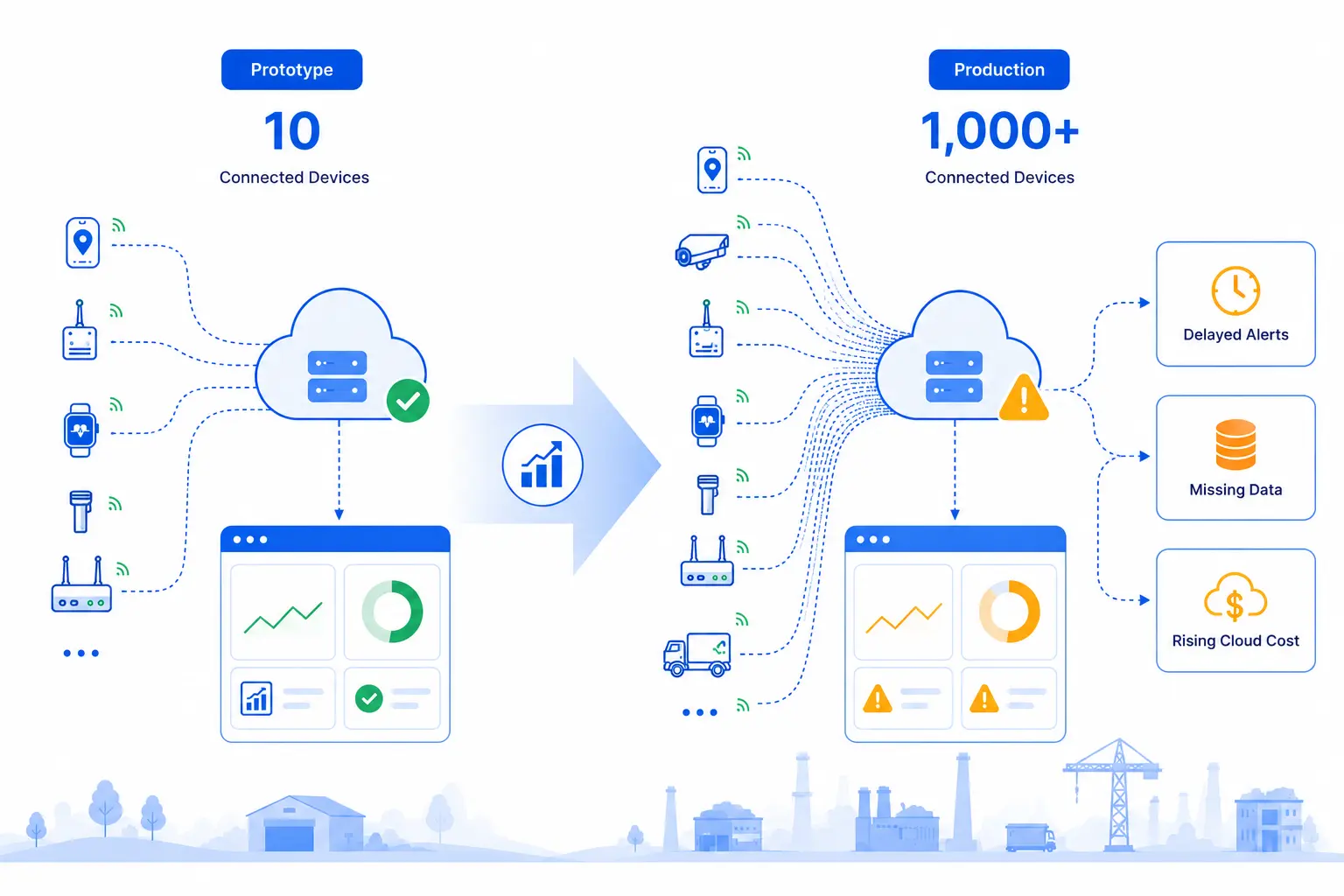
Nobody had written bad code. Nobody had made an obvious mistake. The architecture that worked perfectly at ten devices simply was not built for eight hundred.
This is not an unusual story. It is, in fact, one of the most common inflection points in IoT product development, and it follows a predictable pattern.
The Architecture Decision You Made Early On
When most engineering teams start an IoT backend, serverless is the obvious choice. It removes infrastructure overhead, appears to scale automatically, and costs almost nothing at low volume. For a prototype or internal tool, it is a perfectly reasonable decision.
The issue is that IoT workloads expose serverless limitations when Lambda is used as the primary ingestion layer instead of part of an event-driven architecture. A web API receives a request when a user clicks something. An IoT device sends data continuously, on its own schedule, independent of whether your backend is ready or not.
At ten devices, the difference does not matter. At five hundred, it starts to show. At a thousand, it becomes the dominant engineering problem you are dealing with.
Most serverless IoT tutorials are written for ten devices. Most IoT products need to handle ten thousand. The architectural decisions that work at one scale actively break at the other.
What Actually Breaks, and When
The problems that surface are consistent enough that we recognise them immediately. They fall into four categories and tend to appear roughly in this order as device count increases.
Warning Sign 1
Data Gaps With No Obvious Error to Investigate
Sensor readings start disappearing from your dashboard. You check your Lambda function error logs and see nothing wrong because Lambda never errored. The requests were throttled before execution and never reached your function code.
AWS Lambda starts with a default concurrency limit of 1,000 executions per region, and most teams never think to raise it until they're already dropping data. When hundreds of devices reconnect after a brief network outage and fire simultaneously, depending on the ingestion path, events may be throttled, delayed, retried, or dropped if retry and buffering strategies are not designed correctly. The throttle count appears in CloudWatch Metrics, but only if you are specifically monitoring for it, which most teams are not at launch. Your error rate looks clean. Your Lambda logs look clean. Your data is not.
Warning Sign 2
Alerts That Arrive After the Problem Has Already Happened
Your platform is supposed to send an alert when a temperature sensor crosses a threshold. The alert arrives, but 1 to 3 seconds after the reading that triggered it.
A Lambda function that has not been invoked recently can experience a cold start before processing begins. The exact delay depends on runtime, package size, configuration, and optimization strategies. However, cold starts are only one part of the problem. Chained service calls, database connections, external API calls, and downstream processing delays together create latency spikes. For a wearable health monitor or an industrial safety sensor, inconsistent response times can become a serious reliability concern. The system is technically working. It is just not fast enough to matter.
Warning Sign 3
Device Status That Does Not Reflect Reality
A device reconnects after going offline. Your dashboard still shows its last known state from before the disconnection. Commands sent to the device go unacknowledged.
Serverless functions carry no persistent device state between calls. Every invocation starts fresh, with no knowledge of what that device was doing before. Anything your system needs to remember about a device has to be explicitly stored and retrieved from an external state store on every single event. As device count grows, the race conditions and stale reads multiply.
Warning Sign 4
A Cloud Bill That Grows Faster Than Your Device Count
A single device sending data every 5 seconds generates roughly 520,000 Lambda invocations per month. At 1,000 devices, that is over 500 million invocations, and that is before duration charges, data transfer costs, and every downstream service those invocations touch.
The billing model that felt almost free at prototype scale starts changing as device traffic increases. Lambda invocation cost alone may not be the biggest contributor. The real cost often comes from the entire chain triggered by every event, including API Gateway requests, compute duration, database writes, logs, storage, monitoring, and data transfer. As device volume grows, small inefficiencies in the architecture multiply millions of times.
The Inflection Point
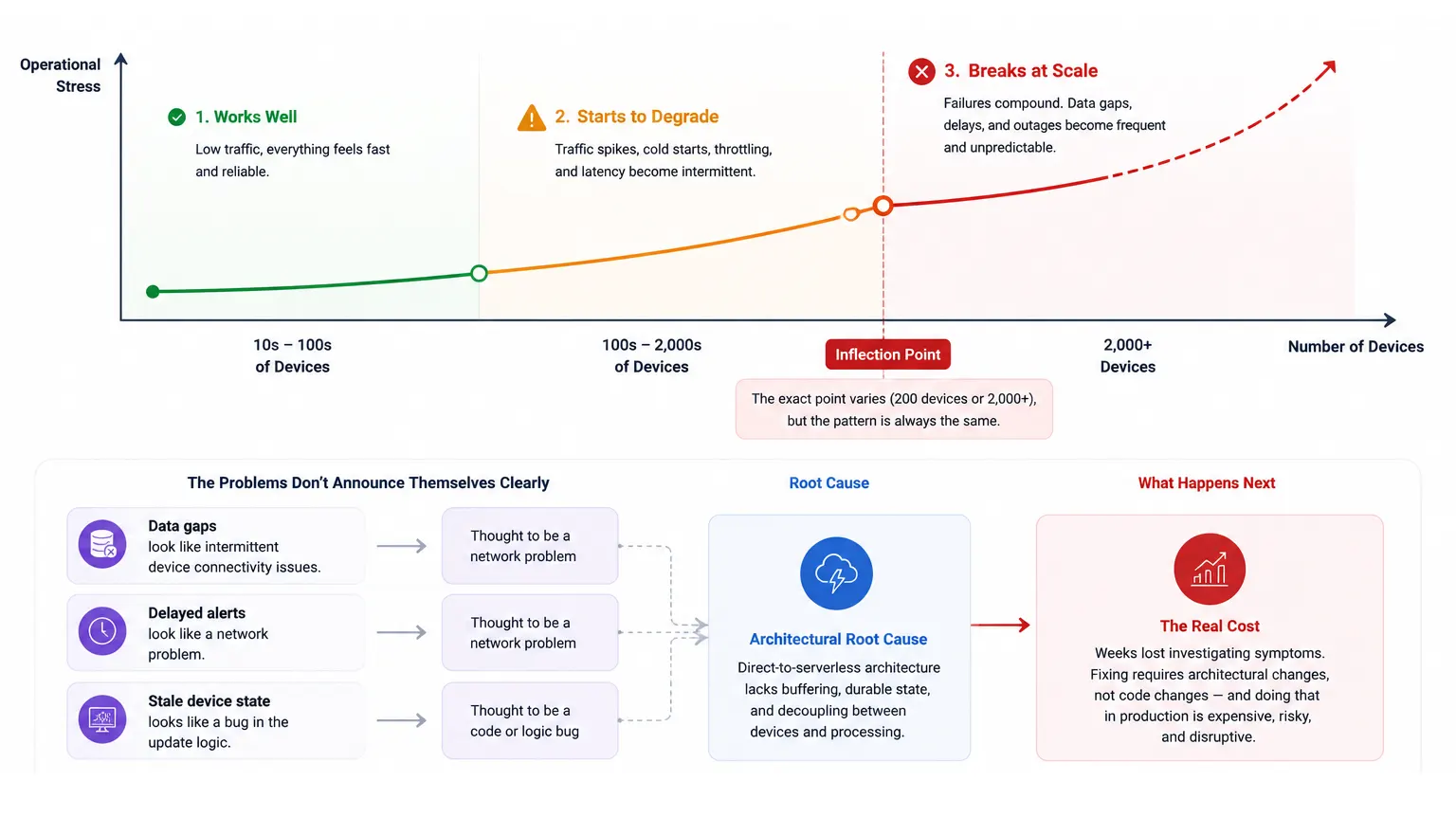
Every IoT product built on a direct-to-serverless architecture hits a version of this wall. The timing varies; some teams hit it at 200 devices, while some at 2,000. The pattern is consistent.
What makes this particularly difficult to plan for is that the problems do not announce themselves clearly:
Data gaps
Looks like intermittent device connectivity issues
Delayed alerts
Looks like a network problem
Stale device state
Looks like a bug in the update logic
Teams spend weeks investigating symptoms before the architectural root cause becomes apparent. By that point, a production product is running on infrastructure that was never designed for the load it is carrying. The fix requires architectural changes, not code changes, and doing that while a live product is in use by real customers is significantly harder than doing it before launch.
The most expensive time to fix an IoT backend architecture is after you have launched.
The second most expensive time is six months before launch, when the team is heads-down on features and the infrastructure feels like it is working fine.
What the Right Architecture Looks Like
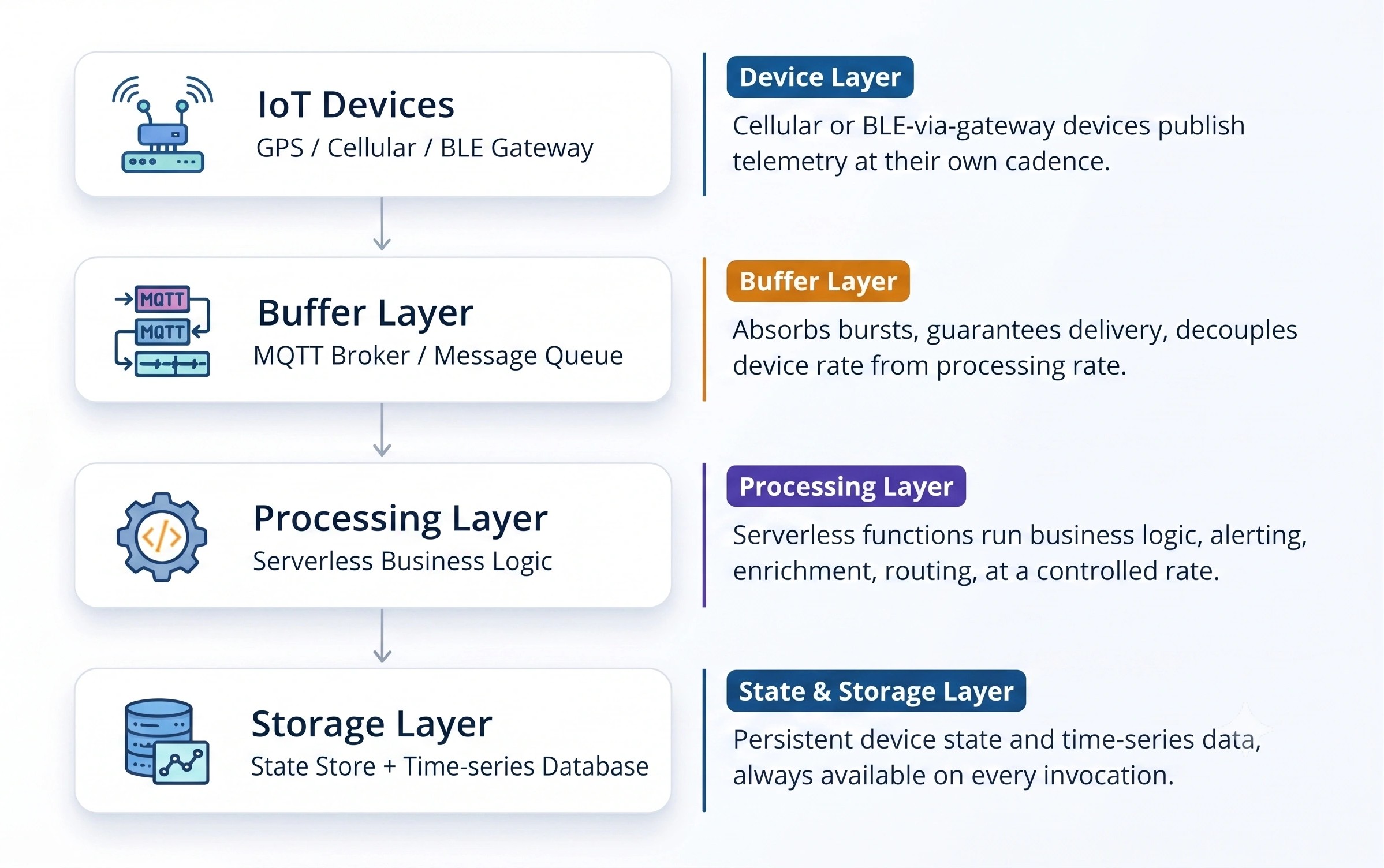
The solution is not to abandon serverless. It is to stop using it as the direct entry point for device data.
A production IoT backend needs a buffer layer between devices and processing logic, something that:
Absorbs reconnect bursts without dropping data
Guarantees event delivery even under surge conditions
Holds device state externally so every invocation has context
Reserves serverless execution for business logic, not ingestion
The teams who get this right typically do so because they have built IoT backends before and know where the walls are. The teams who hit the problems described above typically discover them in production, under pressure, with customers already affected.
Knowing the problems exist is the first step. Knowing how to design around them before they surface is where the real leverage is.
Bluepixel has built IoT backends that scale.
If your product is approaching the inflection point, or already past it, we can help you design an architecture that handles real device traffic before it becomes a production incident.